Greyhound Trap Draw Bias — Does Trap Position Matter?
Best Greyhound Betting Sites – Bet on Greyhounds in 2026
Loading...
The Starting Position That Tilts the Race
If greyhound racing were perfectly fair, every trap would win one-sixth of the time. Trap 1 would win 16.7% of races. So would trap 6. So would every position in between. But greyhound racing is not perfectly fair, because the tracks are not perfectly symmetrical in their effect on outcomes. The geometry of each venue — the distance from the traps to the first bend, the radius of the bends, the camber and width of the running surface — creates a measurable statistical advantage for certain starting positions. This is trap bias, and it is one of the few data-driven edges available to greyhound bettors.
Trap bias is not a theory. It is an empirical observation supported by decades of race results across every licensed UK track. At some venues, the inside traps win significantly more often than the outside traps. At others, the bias is less pronounced but still present. Ignoring it does not make it disappear. Incorporating it into your analysis — alongside form, running style, and grade — gives you a more complete picture of a dog’s chances in a specific race at a specific track.
What Is Trap Bias
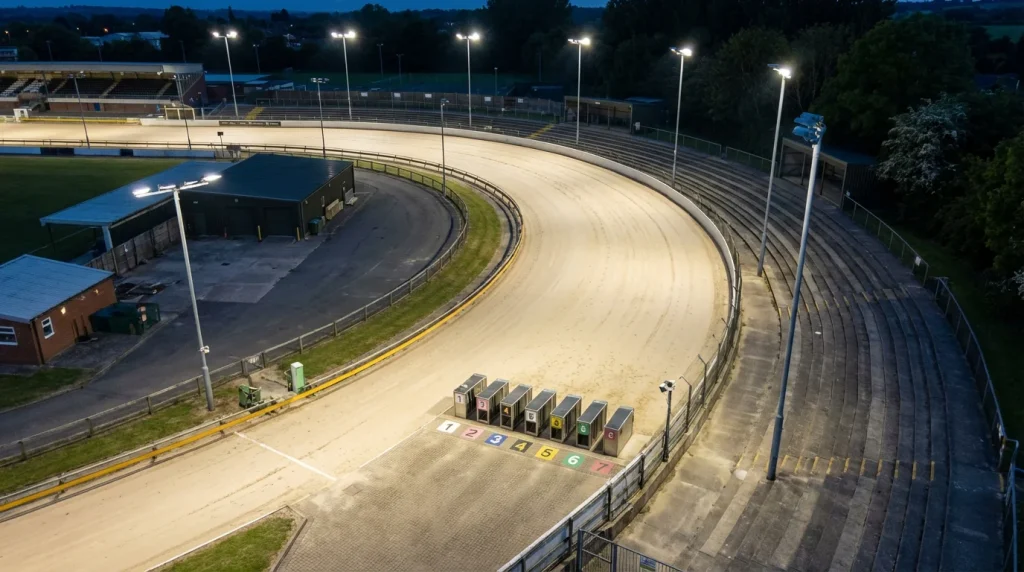
Trap bias refers to the statistical tendency for certain trap positions to produce more winners, or more place finishers, than others at a given track. It is caused by the physical layout of the circuit. In UK greyhound racing, races are run anticlockwise, which means the inside rail is always on the left. Dogs drawn closer to the rail — traps 1 and 2 — have a shorter path to the first bend and can take the bend tighter, saving ground. Dogs drawn wider — traps 5 and 6 — cover more distance on every bend and are more vulnerable to being crowded or pushed even wider by the field.
The bias is strongest at the first bend. This is where the field converges from a spread start into a single-file order, and the dog that arrives first or in the best position at this point typically controls the race. Inside traps need less speed to reach the bend in a good position because the distance is shorter. Outside traps need the dog to be significantly faster just to be competitive at the first bend.
The magnitude of the bias varies dramatically between tracks. At a tight, short-run track like Romford or Crayford, the inside advantage is substantial — inside traps can win at rates five to eight percentage points above the expected 16.7%, while outside traps fall well below it. At a broader, more galloping track like Monmore or Nottingham, the bias is milder. Traps 1 and 2 still hold an edge, but traps 5 and 6 are not as disadvantaged because the wider bends and longer runs give outside dogs more time to find position.
It is worth noting that bias exists not just for first place but also for place finishes. The same track geometry that helps inside traps win also helps them finish in the top two or three. For each way bettors and forecast bettors, the place-finish bias is equally relevant to the win bias.
Track-by-Track Bias Data
Every UK greyhound track has its own bias profile, and that profile can vary by distance. A trap that performs well over the standard 480m trip might not hold the same advantage over 270m or 660m because the relationship between the start position and the first bend changes with the trap layout. Here is a summary of the bias patterns at several major venues, based on aggregate data across recent seasons.
Romford is one of the most biased tracks in the UK. The standard-distance run to the first bend is short, and the bends are tight. Trap 1 consistently wins at rates above 20%, with trap 2 close behind. Traps 5 and 6 are heavily disadvantaged, regularly winning below 14%. Sprint distances at Romford amplify the bias further — the shorter the run, the less time outside dogs have to compensate for the positional disadvantage.
Crayford operates at 380m for many races, and the circuit is compact. Inside traps dominate, with trap 1 and trap 2 posting the highest win rates across all grades. The track surface is well-maintained but the geometry punishes wide runners. Bettors at Crayford should give significant weight to trap draw when assessing a race.
Monmore Green is a fairer track. The bends are wider, the straights longer, and the run to the first bend is more generous than at Romford or Crayford. Trap bias exists but is less extreme — the difference between the best-performing and worst-performing traps is typically five to eight percentage points rather than ten to twelve. Outside traps remain viable here, especially for dogs with stamina and a wide-running style.
Nottingham offers a similar profile to Monmore. It is regarded as one of the fairest circuits in the UK, with trap statistics relatively close to the theoretical equal split. Inside traps still have a small edge, but the margins are narrow enough that form and running style are more decisive than draw.
Hove produces moderate bias. Inside traps hold an advantage at standard distance but the effect is less pronounced than at the tight London circuits. Staying races at Hove — over 695m — can produce different bias patterns because the longer trip allows the field to reshuffle after the opening bends.
Sunderland has a unique profile owing to its track geometry. Trap 2 often outperforms trap 1 here, which is unusual. Bettors who assume trap 1 is always best are caught out at Sunderland. Local data matters more than general assumptions.
The data for all UK tracks is available through the Racing Post, Timeform, and several independent greyhound statistics sites. Most platforms allow you to filter trap performance by track, distance, and time period. Use a minimum twelve-month sample to get reliable figures — shorter periods can be skewed by small sample sizes and seasonal track condition changes.
How to Use Bias in Betting
Trap bias is not a system. It is an input — one factor among several that should inform your betting decisions. The trap statistics tell you that a dog in trap 1 at Romford has a structural advantage. They do not tell you that the dog will win. A poor dog in a good trap will still lose to a good dog in a poor trap. But when two dogs are closely matched on form, the one with the favourable draw deserves more respect.
The most practical application is as a tiebreaker. When your form analysis identifies two or three dogs that could plausibly win, check which one has the better trap draw for the track and distance. If Dog A has marginally better form but is drawn in trap 5 at Romford, and Dog B has slightly weaker form but is drawn in trap 1, the bias data tips the balance towards Dog B. That single data point can be the difference between a winning and losing selection over dozens of bets.
Trap bias is particularly useful in forecast and tricast construction. If you know that traps 1 and 2 at Crayford collectively produce first and second finishers at a rate well above expectation, building forecasts around inside-drawn dogs at that venue is a statistically grounded approach. Over a large number of bets, that structural advantage translates into better returns than randomly assigning first and second positions without regard to draw.
Be cautious about applying bias data from one track to another. Each venue has its own profile, and the data is not transferable. A dog that thrives from trap 6 at Monmore, where wide runners are not penalised, may struggle from trap 6 at Romford, where wide runners are at a severe disadvantage. Always check the specific track’s data before factoring draw into your assessment.
Finally, update your data periodically. Track surfaces are resurfaced, running rails are adjusted, and starting positions can be modified. A track that favoured inside traps three years ago might have a different profile after a major surface renovation. Use the most recent data available, and treat any figures more than two years old with caution.
A Number Is Not Just a Number
The trap number on the racecard is not just an identifier. It is a positional statement that carries statistical weight at every UK track. Ignoring it is ignoring data. Overweighting it is ignoring everything else. The skill is in calibrating how much the draw matters for this race, at this track, over this distance, given this dog’s running style.
The data exists. The Racing Post publishes it. Timeform publishes it. Your bookmaker probably displays it somewhere on the racecard page. All you need to do is check it before you bet — and factor it in alongside form, grade, and running style. It will not turn you into a guaranteed winner. But it will prevent you from making bets that the data says are structurally disadvantaged before the traps even open.