
UK Greyhound Live Stream — The Complete Guide to Watching & Betting on Dog Racing
 Available in US
The complete guide to watching and betting on dog racing — streaming platforms, odds, racecards, tracks and tips for 2026.
Contents
Why UK Greyhound Racing Still Fills the Betting Slips
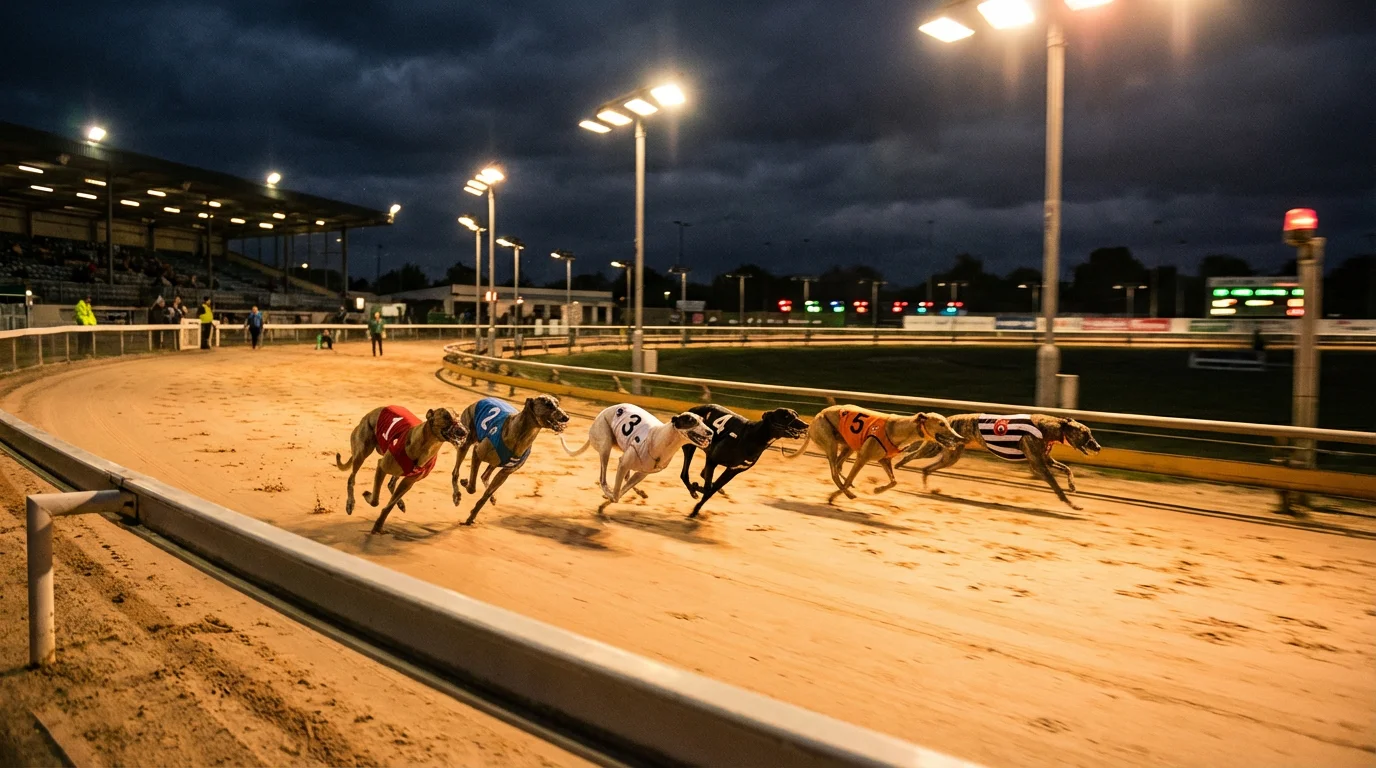
Six traps, thirty seconds, and a mechanical hare — greyhound racing cuts out the noise that bogs down other sports betting. There are no half-time substitutions to second-guess, no managerial mind games to decode, and no rain delays stretching your stake's shelf life into next week. A race opens, the traps spring, and within half a minute you have a result. That cycle repeats hundreds of times a day across more than twenty tracks in the UK, from late morning through to the final evening meeting. For bettors who value pace and volume, nothing else on the British sporting calendar comes close.
Horse racing often gets the column inches and the Channel 4 nostalgia, but greyhound racing quietly generates more individual betting events per day than any other UK sport. The average BAGS afternoon card alone offers ten to twelve races at a single track, and with multiple venues running concurrently, a weekday afternoon can present sixty or more races before the evening meetings even begin. Each race is a self-contained puzzle: a small field, transparent form data, and odds that move fast enough to reward punters who do their homework before the market settles.
What has changed the game in recent years is access. A decade ago, betting on the dogs meant either visiting a stadium or standing in a bookmaker's shop watching a wall-mounted screen. Today, live streaming through licensed bookmakers puts every race on your phone, tablet or laptop. The 2026 racing calendar is busier than ever, with the Greyhound Board of Great Britain overseeing a fixture list that runs practically every day of the year. You can watch a midday sprint from Romford on your lunch break and follow it with an evening stayer at Monmore before the football kicks off — all from the same app.
UK greyhound racing generates 30+ live meetings daily across 20+ licensed tracks, with races streamed via bookmakers from approximately 11am to 10pm. That volume makes it one of the most bet-on sports in Britain by sheer number of daily events.
This guide covers the full loop: where to watch live streams, how to access them, what the betting markets look like, how to read the data that matters, and what separates a considered bet from a coin flip. Whether you already have a funded bookmaker account or you are weighing up your first greyhound wager, the aim is to give you a practical framework — not a sales pitch for any particular platform, but the kind of working knowledge that makes each thirty-second window count.
Where to Watch UK Greyhound Racing Live
The stream you see depends on who broadcasts it, not just which bookmaker you open. UK greyhound racing is distributed through a handful of broadcast providers, each with its own track portfolio, schedule, and access requirements. Understanding who supplies what saves you the frustration of signing up with a bookmaker only to discover it does not carry the meeting you want.
There are three main broadcast pipelines for live greyhound racing in the UK: RPGTV, BAGS-distributed streams, and SIS Racing. Sky Sports Racing also carries selected greyhound meetings, though its focus tilts more toward horse racing. Each channel has different rules about who can watch and what it costs — sometimes nothing beyond a funded account, sometimes a qualifying bet on the race itself.
RPGTV — Free Live Coverage via Bookmakers
Racing Post Greyhound TV is the most visible greyhound broadcast brand in the UK betting space. It covers evening meetings and selected afternoon fixtures from major tracks including Romford, Monmore Green, Nottingham, Hove, and Crayford. The picture quality is solid, the commentary is professional, and the racecard overlay on most bookmaker platforms means you can follow form and odds while watching.
Accessing RPGTV through a bookmaker typically requires a funded account rather than a placed bet. That means you need money deposited, but you do not necessarily have to stake anything on the race you are watching. This makes it the most accessible live greyhound stream in the UK for punters who want to study a few races before committing. Some bookmakers relax the requirement further on RPGTV content, offering it free to any registered customer.
The main limitation is scheduling. RPGTV does not cover every meeting on the daily card — particularly the midday BAGS fixtures that form the backbone of daytime greyhound betting. For those, you need a different feed.
BAGS Streaming — Daytime Racing Access
The Bookmakers' Afternoon Greyhound Service is the engine behind the majority of UK daytime greyhound racing. BAGS meetings run from late morning through the afternoon and into early evening across tracks like Swindon, Henlow, Harlow, Kinsley, and Central Park. These are the bread-and-butter fixtures — high-frequency, shorter-distance races designed for the betting market.
Streaming BAGS content through a bookmaker usually requires a qualifying bet. The threshold is low: a minimum stake of 50p on a win market or 25p each way on a runner in the meeting you want to watch. Place the bet, and the stream unlocks for that session. It is a small cost of entry, and many regular greyhound bettors barely notice it since they would be wagering on those races anyway.
SIS Racing — 24/7 Greyhound Content
SIS (Satellite Information Services) is the other major distribution platform for UK greyhound racing. SIS streams are embedded directly into bookmaker websites and apps, covering a wide range of tracks across both afternoon and evening sessions. The company also operates sisracing.tv, a standalone viewing platform where you can watch live meetings without routing through a bookmaker — useful if you want to study races without the distraction of bet prompts.
BAGS — Bookmakers' Afternoon Greyhound Service. The commercial framework that schedules and distributes daytime greyhound racing to UK betting operators, funded by a levy on bookmaker turnover.
SIS integrates tightly with bookmaker platforms, often providing the data feed alongside the video stream. When you click on a race time and the stream loads with an embedded racecard, odds ticker, and commentary audio, the chances are you are watching an SIS production. The coverage extends to Irish greyhound racing as well, which adds international fixtures to the daily menu without requiring a separate account or platform.
RPGTV
Access: funded bookmaker account. Cost: free with deposit. Coverage: major evening tracks, selected afternoon meetings. Best for: studying races before betting.
BAGS
Access: qualifying bet required. Cost: minimum 50p win / 25p each way. Coverage: daytime racing, multiple tracks. Best for: high-volume afternoon betting.
SIS Racing
Access: bookmaker or sisracing.tv. Cost: varies by platform. Coverage: wide track portfolio, UK and Irish racing. Best for: continuous coverage throughout the day.
Sky Sports Racing
Access: Sky TV subscription or selected bookmakers. Cost: subscription-based or free via funded account. Coverage: selected meetings, mixed with horse racing. Best for: viewers already within the Sky ecosystem.
How to Stream Greyhounds — Step by Step
Open an account, find the race, click play — but each bookmaker has its own gate you pass through first. The process is broadly the same across all major UK betting sites, though the interface layout and specific requirements vary enough to trip up first-timers. Here is the general sequence, applicable to both desktop and mobile.
First, register with a licensed UK bookmaker if you have not already. You will need to provide ID verification — a passport or driving licence scan — to comply with UK Gambling Commission regulations. This step is non-negotiable and applies to every legal operator. Deposit funds once verified. Most bookmakers accept debit cards; some also take PayPal, Skrill, or bank transfer. Credit card gambling deposits have been banned in the UK since April 2020, so do not expect that option.
Once your account is funded, navigate to the greyhound racing section. On most platforms, this sits alongside horse racing and football in the main sports menu. You will see a list of today's meetings, ordered by race time. Click on a specific meeting or race to open the racecard view. Somewhere near the top of the racecard — or beside the race time header — there will be a video icon, a "Watch Live" button, or a play symbol. That is your stream.
Whether the stream activates immediately depends on the broadcast source. RPGTV meetings usually require only a funded account. BAGS meetings typically demand a qualifying bet: place a minimum wager on any runner in that race, and the video unlocks. If the race has not started yet, some bookmakers show a countdown or a pre-race camera feed from the track. On mobile, the stream usually appears in a floating player at the top of the screen, so you can scroll through the racecard and place bets without losing the video.
Example Bet
| Dog | Trap | Odds | Stake | Return |
|---|---|---|---|---|
| Ballymac Doris | 3 (White) | 5/2 | £5.00 | £17.50 |
At odds of 5/2, a £5 win bet returns £12.50 profit plus your £5 stake — a total of £17.50 if the dog finishes first.
If the video does not load, check two things: your account balance (a zero balance may block RPGTV streams) and whether you have placed the qualifying bet for BAGS content. Audio commentary is usually available as a fallback if the video stream buffers or if your connection drops — look for a speaker icon or an audio-only toggle. Commentary feeds run on far less bandwidth and rarely cut out, which makes them a practical backup during peak traffic.
Desktop browsers generally deliver the smoothest streaming experience, but mobile apps from the larger bookmakers have improved dramatically. Full-screen mode on a phone gives you a surprisingly watchable picture, especially on Wi-Fi. If you are on mobile data, expect occasional resolution drops during the busiest periods around evening race times.

Greyhound Betting Basics — What You Need Before the Traps Open
Knowing the bet types is half the work. The other half is knowing when not to use them. Greyhound betting looks simple from the outside — pick a dog, place a bet, watch the race — but the structure underneath offers more texture than most casual bettors realise. The small field size (typically six runners) makes every bet type behave differently compared to horse racing or football, and understanding those differences is the gap between throwing darts and placing considered wagers.
How Greyhound Odds Work
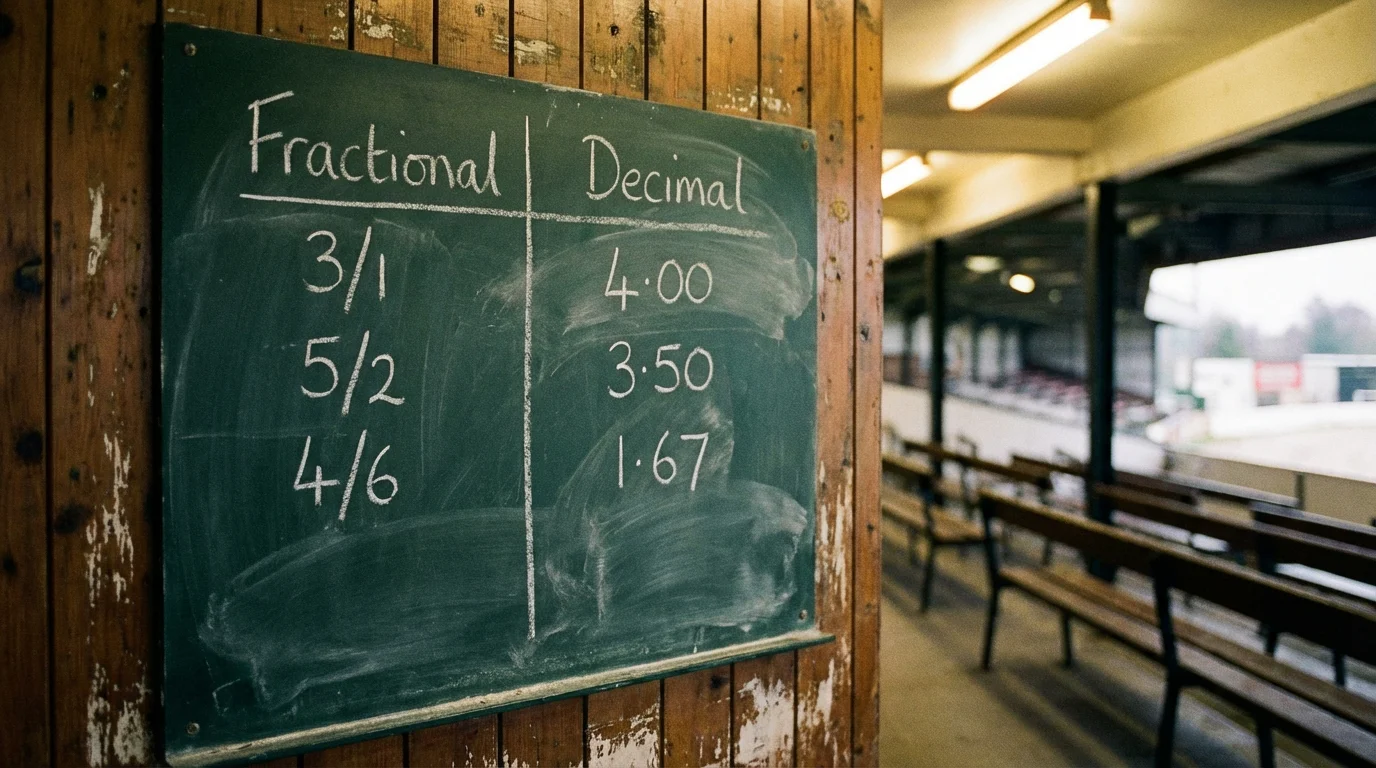
UK bookmakers display greyhound odds in two formats: fractional and decimal. Fractional odds are the traditional format — the one you see chalked on boards at the track and printed in Racing Post form guides. An odds-on favourite at 4/6 tells you the market thinks this dog wins more often than not. A 5/1 outsider tells you the opposite. The numerator is your profit, the denominator is your stake: at 3/1, every pound you risk returns three pounds of profit plus your original stake.
Decimal odds do the same job with less mental gymnastics. Decimal 4.00 equals fractional 3/1. Multiply your stake by the decimal price and you get your total return, stake included. Exchange platforms and European bookmakers tend to default to decimal, which is why it has become more common even in the UK market.
Both formats express the same underlying concept: implied probability. Odds of 2/1 imply a 33.3% chance of winning. Odds of 1/2 imply a 66.7% chance. The combined implied probability of all dogs in a race always exceeds 100% — that surplus is the bookmaker's margin, and it is how they stay in business. In greyhound racing, the starting price (SP) is determined at the moment the traps open, based on the final state of the on-course market, though online money and exchange activity increasingly influence it.
Fractional Odds
Format: 5/2, 3/1, 4/6
Return calculation: (stake x numerator / denominator) + stake
Example: £10 at 5/2 = £25 profit + £10 stake = £35 total
Best for: traditional UK bettors, on-course pricing, Racing Post readers
Decimal Odds
Format: 3.50, 4.00, 1.67
Return calculation: stake x decimal odds
Example: £10 at 3.50 = £35 total return
Best for: exchange users, cross-sport bettors, quick comparison
Core Bet Types — Win, Place, Each Way
A win bet is the simplest wager in greyhound racing: your dog crosses the line first, you collect. It finishes anywhere else, you lose. In a six-runner race, the arithmetic favours the bookmaker, but the directness of a win bet appeals to punters who prefer clean outcomes. No place terms, no consolation prizes — just a binary result.
Place betting in greyhound racing typically covers the first two finishers. This is more conservative than horse racing place terms, where larger fields can mean first, second, and third all count. In a standard six-dog race, the place fraction is usually 1/4 of the win odds. So a dog at 4/1 for the win would pay around evens (1/1) for a place finish. The reduced return reflects the higher probability of a top-two finish compared to an outright win.
Each way is not a single bet but two: a win bet and a place bet at equal stakes. If your dog wins, both halves pay out — you collect the full win odds plus the place portion. If your dog finishes second, the win half loses but the place half returns. A £5 each way bet costs £10 in total (£5 on win, £5 on place), which is a distinction that catches out beginners. Each way works best on dogs priced at 3/1 or longer, where the place return alone can cover your total outlay.
Forecast, Tricast and Combination Bets
A forecast bet requires you to predict the first and second dog in the correct order. A straight forecast on Trap 1 to win and Trap 4 for second pays out only if that exact sequence occurs. The dividend is not set by fixed odds but calculated by a computer after the race, based on the starting prices of the dogs involved and the overall market. This means you do not know your exact return until the result is confirmed — which adds a layer of unpredictability but also produces some impressively large payouts when outsiders fill the top spots.
A reverse forecast covers both permutations: Trap 1 first with Trap 4 second, or Trap 4 first with Trap 1 second. It costs twice the unit stake but doubles your chances. A combination forecast selects three or more dogs and covers all possible first-second pairings between them. With three dogs selected, that is six permutations — six times your unit stake.
Tricasts extend the principle to the first three finishers. A straight tricast demands the exact finishing order of three named dogs — a low-probability bet that can return eye-catching dividends. A combination tricast covers all permutations of your selected dogs in the top three positions. With three dogs, that is six combinations; with four dogs, twenty-four. The stake multiplies quickly, so managing your unit stake matters. Computer-calculated tricast dividends in greyhound racing can range from modest (when three short-priced dogs fill the frame) to extraordinary (when a 10/1 outsider sneaks into the places and rearranges the entire payout grid).
Reading the Greyhound Racecard
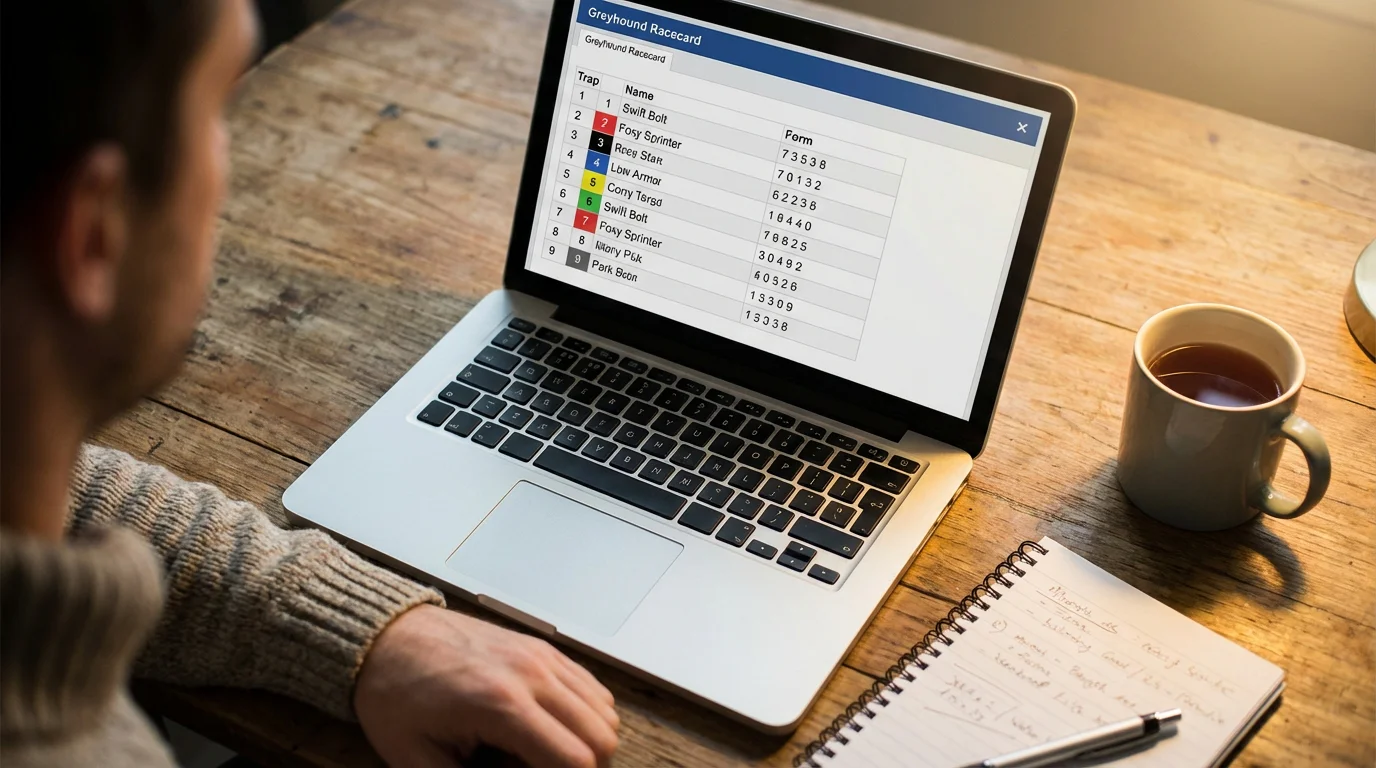
A racecard is compressed data — once you learn the shorthand, half a minute of reading replaces ten minutes of guesswork. Every UK greyhound race is accompanied by a racecard published by the track and distributed through bookmakers, Racing Post, and dedicated greyhound data services. It contains everything you need to assess a dog's chances: recent form, times, weight, trainer, grade, and trap draw. The problem for newcomers is that it is packed into an abbreviation-heavy format that looks like encrypted text until you know the code.
Form Figures and Recent Runs
The most prominent data on any racecard is the form string — a sequence of numbers and letters representing a dog's finishing positions in its last six races. A form string of 211132 tells you this dog won its most recent race (reading right to left, the rightmost number is the latest run), finished third before that, won the two races before that, and so on. Consistency in the form string matters more than a single flashy win. A dog showing 222211 — second, second, second, second, first, first — is a reliable contender, even though it has not dominated. It finishes close to the front and knows how to compete.
Letters in the form string carry specific meanings. "M" indicates the dog was impeded or bumped at a crucial stage (often annotated further with qualifying codes). Common notations include MSBK (moved sideways, bumped, knocked), BMP1 (bumped at the first bend), SAW (stumbled at the wire), and DNF (did not finish). These annotations explain anomalous results. A dog with a form figure of 6 who was recorded as BMP1 may have been in contention before being taken out of the race by a collision. Dismissing a sixth-place finish without checking the comment is a frequent mistake.
Weight changes also appear on the racecard. A dog gaining or losing more than a kilogram between runs can indicate a change in condition. Moderate weight loss might signal sharper fitness; excessive loss could mean a health issue. Trainer form — the recent strike rate of the kennel handling the dog — is another piece of context that experienced punters factor in alongside the raw form numbers.
Sectional Times and Calculated Grade Times
Raw finishing times tell you how fast a dog ran a specific distance at a specific track. Sectional times break that performance into segments — how quickly the dog reached the first bend, how it ran the back straight, and how it finished. A dog with a fast first sectional is an early pace runner, likely to lead from the traps and hold position through the bends. A dog with a slow first sectional but a rapid final segment is a closer, a dog that comes from behind and relies on stamina and a clear run in the straight.
The problem with raw times is that they are not directly comparable across tracks. Romford's 350-metre circuit and Towcester's 500-metre distance produce fundamentally different time profiles. Calculated grade times solve this by adjusting for track, distance, and race grade to produce a normalised figure. Two dogs with identical calculated times — one from an A3 race at Crayford, another from an A5 race at Nottingham — can be reasonably compared, even though the raw times look nothing alike. Most serious form analysts rely on these adjusted times rather than raw splits when assessing cross-track form.
Always check for non-runners before placing forecast or tricast bets. A withdrawn dog reshuffles the entire market — the remaining runners move to different trap positions, and the race dynamics change.
UK Greyhound Tracks — A Quick Rundown
Twenty-odd tracks, each with its own geometry, sand, and peculiarities. UK greyhound stadiums are not interchangeable — track circumference, run-up distance to the first bend, sand depth, and even local weather patterns create distinct racing profiles. A dog that dominates on Romford's tight 350-metre circuit may struggle at Towcester, where the longer distances and demanding bends expose different weaknesses. Knowing the character of the tracks you bet on is a quiet edge that most casual punters skip.
Romford is arguably the most-bet-on greyhound track in the country. It runs multiple meetings per week — both BAGS afternoons and RPGTV evening fixtures — and its compact layout rewards early-speed dogs that break cleanly from the traps. The first bend arrives quickly, so trap draw matters enormously here. Inside traps (1 and 2) carry a statistical advantage at Romford that is measurable across years of data. If you bet on Romford regularly and ignore trap bias, you are giving away information.
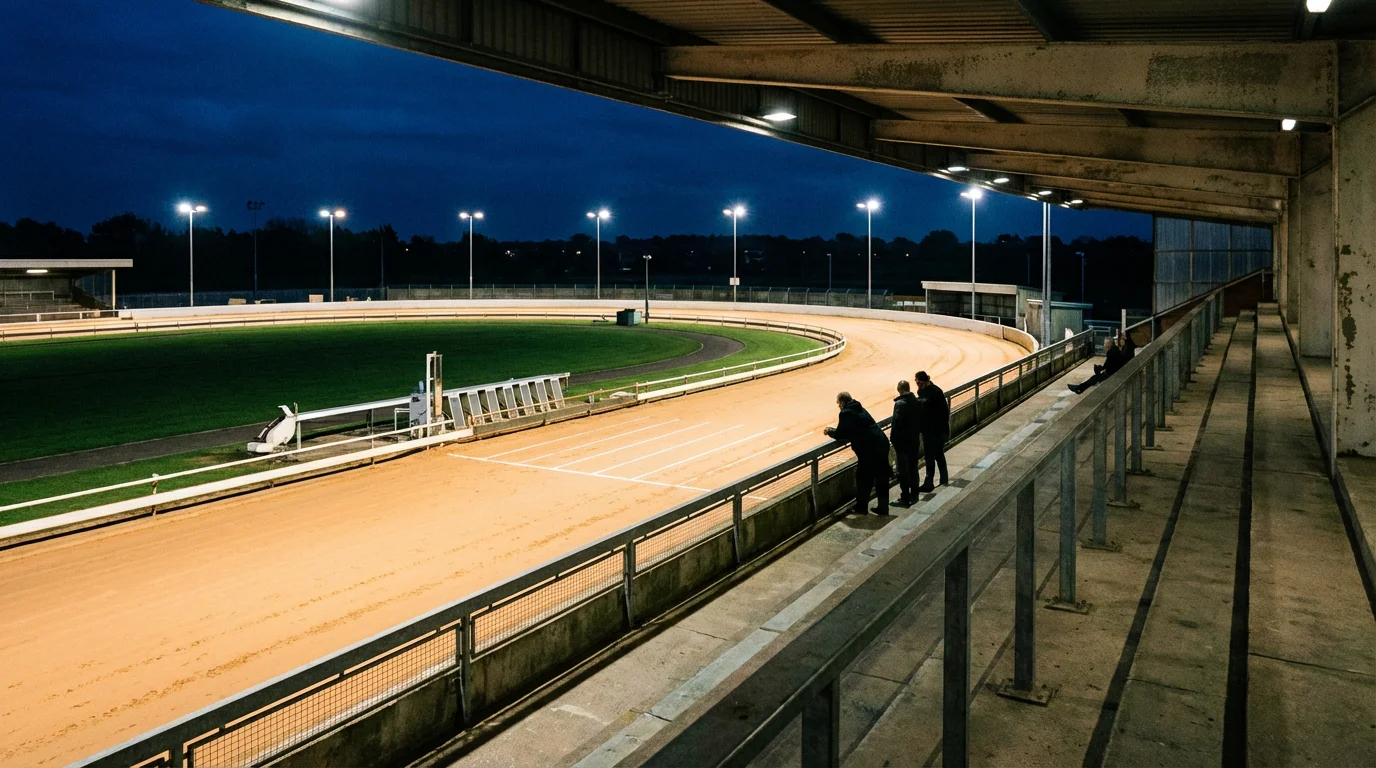
Monmore Green in Wolverhampton is a larger, more galloping track that suits stayers and dogs with mid-race acceleration. The longer run to the first bend means trap draw is less decisive, and dogs that close from behind have more room to manoeuvre. Hove, on the south coast near Brighton, is a popular evening venue with a balance of sprint and middle-distance races. Crayford in Kent runs high-frequency BAGS meetings and is a staple of the afternoon betting card. Nottingham's Colwick Park track is one of the more modern venues, with a circuit that produces fair racing across all trap positions.
Towcester in Northamptonshire deserves a special mention. Its 420-metre circumference oval features some of the widest bends in UK greyhound racing, and the venue hosts the sport's most prestigious event — the English Greyhound Derby, run over 500 metres. The 2026 Derby — the race that defines the sport's calendar — will once again draw attention to Towcester's demanding layout, where sustained speed over an extended distance separates the elite from the merely quick. For bettors, the track's unique characteristics mean form from Towcester does not transfer easily to shorter, tighter venues.
The first official greyhound race meeting in Britain took place at Belle Vue, Manchester on 24 July 1926 — 1,700 spectators turned up to watch six races where dogs chased a mechanical hare around an oval.
Other venues worth tracking include Swindon, Henlow, Harlow, Central Park, and Kinsley — all regular BAGS fixtures that generate consistent betting markets. Each has its quirks: Henlow's short run-in, Swindon's sweeping bends, Central Park's sandy surface that changes pace after rain. The point is not to memorise every track's dimensions but to recognise that form is always track-dependent. A dog's time at Harlow tells you something about that dog at Harlow. Assume it transfers cleanly to Romford and you are guessing.
From the tracks to the traps — what to look for before you bet.
Greyhound Betting Tips — Form, Traps and Conditions
Favourites win about a third of the time. That leaves two-thirds of races where the value sits elsewhere. Greyhound betting tips are not about picking the most obvious dog — they are about finding spots where the market undervalues a runner based on readable factors. The three pillars of greyhound form analysis are recent race history, trap draw relative to the track, and prevailing conditions. None of them works in isolation, but taken together they build a picture that static odds cannot capture.
Analysing Recent Form
Start with the last six runs. You are looking for patterns, not highlights. A dog that has finished first, second, first, second, first, second is as interesting as one that has won five in a row, because that level of consistency tells you the dog competes hard and places well in its grade. Contrast that with a form string of 165213 — wildly inconsistent, bouncing between dominant wins and poor finishes. That volatility could mean the dog is affected by trap draw, bumping, or fitness fluctuations.
Look beyond the positions. Check the comments on each run. A dog that finished fourth but was bumped on the first bend (BMP1) may have been in winning contention before the incident. Similarly, a first-place finish against weak opposition in a downgraded race tells you less than a second-place run in a higher grade. Weight changes between runs offer another signal: a dog shedding half a kilogram might be peaking in fitness, while one gaining a kilogram after a rest could be returning short of full sharpness.
Trainer form adds context. Some kennels hit purple patches where multiple dogs are performing above their rating. If a trainer is running at a 30% strike rate over the past fortnight, their runners deserve extra attention regardless of individual form figures. Most racecard services display trainer statistics alongside dog data — use them.
Trap Draw and Track Bias
Trap draw is the single most underrated factor in casual greyhound betting. On tight tracks with a short run to the first bend — Romford being the prime example — inside traps statistically outperform outside traps by a significant margin. The geometry is straightforward: a dog in Trap 1 has the shortest distance to the rail and arrives at the bend with a positional advantage. A wide runner in Trap 6 needs to cross the entire width of the track to find the rail, and any bumping in the early metres compounds the disadvantage.
The bias is not universal. At tracks with longer runs to the first bend — Monmore, Towcester, Nottingham — the advantage flattens out. Dogs in Trap 6 have time to find position before the first bend arrives, and the wider draw can even benefit runners with early pace who want clear running on the outside. Track-specific trap statistics are published by several data services, and many racecard platforms include historical trap win percentages for each venue. A two-minute check before placing a bet can tell you whether the trap your dog is drawn in is a help, a hindrance, or neutral at that particular circuit.
Weather and Going Conditions
Rain changes everything on a sand track. A wet surface is heavier, slower, and more physically demanding. Dogs that rely on blistering early speed tend to fade on a rain-affected track because the soft ground saps their acceleration. Stronger, more powerful dogs — the stayers and the bulldozers — come into their own when conditions deteriorate, because the race becomes a test of stamina rather than pure pace.
Speed figures and sectional times set in dry conditions lose their predictive value after heavy rain. If the form you are reading was compiled across a spell of dry weather and tonight's meeting follows an afternoon downpour, the data needs mental adjustment. Some bettors ignore going conditions entirely; others treat it as the deciding factor in marginal races. The sensible approach sits between those extremes: check the forecast, note whether the track reports soft or standard going, and downgrade form that was set on a markedly different surface. It is not an exact science, but acknowledging that conditions affect results puts you ahead of anyone who bets blind.
Bookmakers for Greyhound Live Stream & Betting
Not every bookmaker treats greyhound racing as a priority — the ones that do stand out quickly. The difference between a bookmaker that takes greyhound betting seriously and one that treats it as an afterthought shows up in several measurable ways: streaming coverage, odds quality, market range, and the tools they provide for form analysis. Evaluating these criteria before committing to a platform saves frustration later, especially if you plan to bet regularly on the dogs rather than dip in once a month.
Live streaming is the most visible differentiator. Some bookmakers offer broad greyhound streaming coverage across RPGTV, BAGS, and SIS content, while others carry only selected meetings or limit streams to customers who have placed a bet. Check whether the bookmaker requires a funded account or a qualifying bet for each stream, and whether they cover the tracks you follow. A bookmaker with excellent football coverage but sparse greyhound streams is the wrong tool for this job.
Best Odds Guaranteed (BOG) is a feature that matters more in greyhound racing than in most sports. BOG means that if you take an early price on a dog and the starting price (SP) drifts to a higher number, the bookmaker pays you at the better price. In a market where prices can shift sharply in the minutes before a race — especially in smaller fields where one large bet moves the entire book — BOG removes the timing risk from taking early value. Not all bookmakers offer BOG on greyhounds; some restrict it to horse racing only. Confirm before you assume.
The range of markets available also varies. Most bookmakers cover win, place, each way, forecast, and tricast as standard. Fewer offer combination forecasts, tricast doubles, or trap challenge specials. If your betting style relies on exotic markets, check that the bookmaker supports them before depositing. Similarly, the quality of embedded racecards, form data, and statistical tools differs significantly. Some platforms display a full form guide within the racecard interface; others provide only the bare odds and leave you to source form data elsewhere.
Mobile app performance matters if you plan to watch and bet from a phone. Test the streaming quality, the speed of bet placement, and whether the app supports in-play betting on greyhounds. A stream that buffers every ten seconds or a bet slip that takes three taps too many will cost you opportunities in a sport where races last half a minute. The best greyhound bookmakers combine smooth video, fast bet execution, and integrated data in a single interface — and they exist, even if they are not the household names dominating television advertising.
Do
- Compare two or three bookmakers on streaming range, BOG, and greyhound market depth before settling on one.
- Check whether the bookmaker offers Best Odds Guaranteed on greyhound racing specifically, not just horse racing.
- Test mobile streaming and bet placement speed on your own device before committing regular stakes.
- Read the withdrawal terms — processing speed varies widely between operators.
Don't
- Sign up with a bookmaker solely for a welcome bonus without checking their greyhound coverage.
- Ignore withdrawal speed and limits — a bookmaker that takes five days to process a payout creates unnecessary friction.
- Skip the terms and conditions for streaming access — some operators change their qualifying bet thresholds without notice.
- Assume all bookmakers offer the same greyhound odds — prices vary, and the difference adds up over hundreds of bets.
Greyhound Live Stream & Betting — FAQ
Do I need to place a bet to watch greyhound live streams?
It depends on the broadcast source and the bookmaker. RPGTV content — which covers most evening meetings and selected afternoon fixtures — typically requires only a funded account. That means you need a cash balance deposited with the bookmaker, but you do not have to place a bet on the specific race you want to watch. You can sit, observe, and study form for free as long as there is money in your account.
BAGS content works differently. Most bookmakers require a qualifying bet before the stream unlocks. The minimum threshold is usually a 50p win bet or a 25p each way bet on a runner in the meeting you want to watch. It is a small cost, but it is a gate — no bet, no video. A handful of bookmakers take a more relaxed approach and offer all greyhound streams to any customer with a funded account, regardless of whether a bet has been placed. Coral has historically been one of the more generous operators in this regard, though policies change, so check the current terms before relying on it.
SIS Racing offers an alternative route through its own platform, sisracing.tv, where live meetings are available without a bookmaker account. The trade-off is that you cannot place bets directly through SIS — it is a viewing platform, not a betting one. For punters who want to combine watching and wagering in the same interface, a bookmaker account remains the most practical option.
How do greyhound racing odds work?
Greyhound odds represent the bookmaker's assessment of each dog's probability of winning, expressed as a price that determines your potential payout. In the UK, odds are most commonly displayed in fractional format — 3/1, 5/2, 4/6 — where the first number represents your potential profit relative to the second number (your stake). At 3/1, a £1 bet returns £3 profit plus your £1 stake. At 4/6, you need to stake £6 to win £4.
Decimal odds present the same information in a single number that includes your stake in the return calculation. Decimal 4.00 equals fractional 3/1: multiply your stake by 4.00 and you get your total return. This format is standard on betting exchanges and increasingly common on bookmaker platforms, where you can usually toggle between the two.
Behind every set of odds is an implied probability. Fractional 2/1 implies a roughly 33% chance of winning. Fractional 1/2 implies roughly 67%. If you add up the implied probabilities of all six dogs in a race, the total will exceed 100% — that surplus is the bookmaker's built-in margin (the overround), and it is the price you pay for the convenience of the market. The starting price (SP), determined at the moment the traps open, reflects the final state of the market. Taking an early price can sometimes secure better value if you believe the odds will shorten before the off.
What are forecast and tricast bets in greyhound racing?
A forecast bet asks you to predict the first two finishers in a greyhound race. In its simplest form — the straight forecast — you name the dog that will finish first and the dog that will finish second, in that exact order. If the result matches your selection, you collect a dividend calculated by computer after the race based on the starting prices of the dogs involved. There are no pre-set odds; the payout is determined by the market at the time of the result.
Variations broaden the bet. A reverse forecast covers both possible finishing orders of your two selected dogs (either A first and B second, or B first and A second), costing twice the unit stake. A combination forecast lets you select three or more dogs and covers every possible first-second pairing among them. With three dogs, that is six permutations and six times your unit stake; with four dogs, twelve permutations.
Tricast bets extend the concept to the first three finishers. A straight tricast requires you to name the first, second, and third dogs in exact order — a demanding bet with correspondingly large dividends when it lands. A combination tricast selects three or more dogs and covers all possible finishing orders for the top three positions. Three dogs produce six permutations; four dogs produce twenty-four. The stake escalates quickly, so managing your unit cost is essential. Tricast dividends in greyhound racing can run from double-digit returns (when three favourites fill the frame) to four-figure payouts (when an outsider gatecrashes the result). The unpredictability is the attraction — and the risk.
Thirty Seconds at Forty Miles Per Hour
Every race resets the clock. That is the defining quality of greyhound racing as a betting medium, and it is the reason the sport sustains a volume of daily wagering that most punters never fully appreciate. A football match takes ninety minutes to produce a result. A horse race can stretch to three or four minutes across a mile-and-a-half course. A greyhound race over 480 metres is done in under thirty seconds. Six dogs, one hare, a mechanical lure that never gets caught, and a result that arrives before you have finished your drink.
That compressed timeframe creates a rhythm unlike anything else in the UK betting calendar. You can study a racecard, place a bet, watch the race, assess the result, and move on to the next event in less time than it takes for a VAR check in the Premier League. The speed is addictive, but it is also informative. Greyhound racing strips away the variables that complicate other sports — there are no teammates making errors, no weather cancellations, no tactical fouls. What you see is a test of physical ability, trap draw, early pace, and racing luck, all compressed into a sprint that rewards dogs who break cleanly and hold their line through the bends.
Live streaming has transformed this experience from a niche pursuit into something any bettor with a smartphone can access between other commitments. The 2026 BAGS fixture list runs across more than twenty tracks from morning to evening, seven days a week. RPGTV and SIS between them broadcast practically every race to bookmaker platforms. You are no longer limited to the three or four meetings your local betting shop chose to put on its screens. You can follow form at a specific track, build knowledge of particular trainers and dogs, and develop a specialised approach that the generalist punter never bothers with.
What makes greyhound betting distinct from throwing money at accumulators on the weekend football is the transparency of the data. Racecards, form figures, sectional times, trap statistics, trainer records, and grade histories are all publicly available. The information is not hidden behind a press conference or a manager's tactical ambiguity. It is printed, timestamped, and waiting for anyone willing to do the reading. The bettors who treat greyhound racing seriously — who check the form, note the non-runners, respect the track bias, and compare their own assessment against the market — are the ones who find value consistently, not the ones who pick a name they like and hope for the best.
Thirty seconds at forty miles per hour. It does not leave much room for second-guessing, and that is exactly the point.
