
History of Greyhound Racing in the UK — 1926 to Now
 Available in US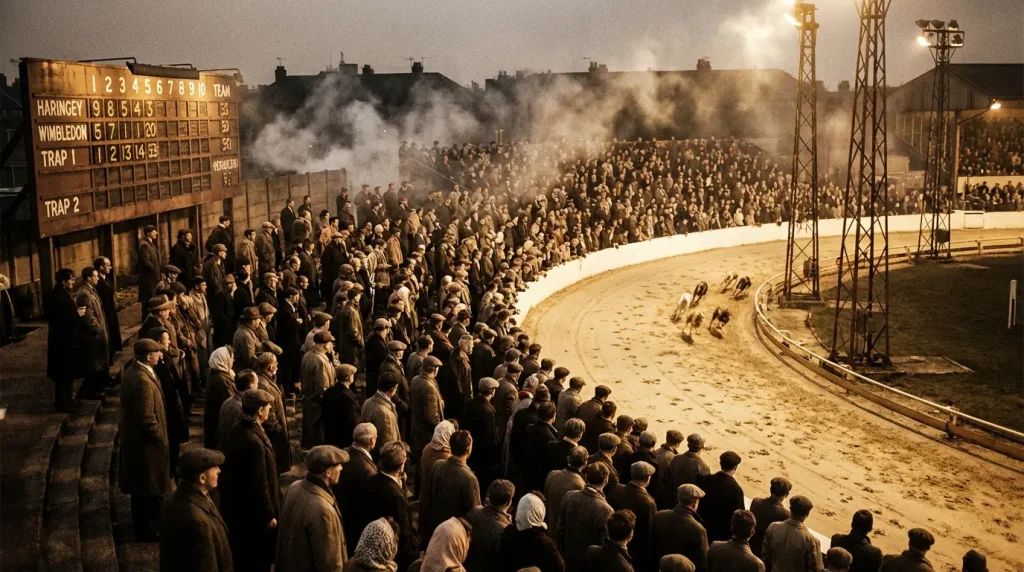
A Hundred Years and Still Running
Greyhound racing in the UK is approaching its centenary — a century that began with a borrowed idea from America, exploded into a mass working-class entertainment, survived decades of decline, and is now being reshaped by live streaming and mobile betting. The story of the sport is inseparable from the story of British leisure, class, and gambling. At its peak, greyhound racing attracted larger crowds than football. At its lowest, it was an afterthought, clinging to a handful of surviving tracks while stadiums were demolished for housing developments. In 2026, the sport finds itself in an unusual position: smaller than it has ever been in terms of venues, but more accessible than it has ever been in terms of reach.
Understanding the history matters for the modern bettor, not because the past predicts the odds, but because it explains why the sport is structured the way it is — why BAGS exists, why grading works the way it does, why certain tracks survived while others disappeared, and why live streaming turned out to be the lifeline nobody expected.
1926 — Belle Vue and the Birth of Modern Racing
The first official greyhound race under modern rules in Britain took place on 24 July 1926 at Belle Vue Stadium in Manchester. An American businessman named Charles Munn, together with a retired British Army officer named Major Lyne-Dixson, had imported the idea from the United States, where greyhound racing with a mechanical hare had been running since 1919. The Belle Vue meeting drew 1,700 spectators — a respectable number for a sport that nobody in the country had seen before.
Within months, the response made it clear that greyhound racing had tapped into something. By the end of 1926, tracks were opening across England. White City in London launched in June 1927 and quickly became the sport’s premier venue. Wembley followed. So did tracks in Birmingham, Glasgow, Edinburgh, Cardiff, and dozens of smaller cities and towns. The expansion was extraordinary — by the end of 1927, there were around forty greyhound tracks operating in Britain, and the number continued to grow rapidly through the following decade.
The appeal was straightforward. Greyhound racing was accessible. Meetings were held in the evening, after working hours, making them available to factory workers, labourers, and office clerks who could not attend afternoon horse racing. The tracks were in cities, not in the countryside. The admission prices were low. The betting was fast, simple, and produced a result every fifteen minutes. For a working-class population with limited leisure options and disposable income that went further at the dogs than at any other form of entertainment, greyhound racing was irresistible.
The sport’s first superstar was Mick the Miller, an Irish-bred dog that won the Greyhound Derby in 1929 and 1930 — the only dog at that point to win the race twice. Mick the Miller became a genuine celebrity, appearing in a feature film and generating newspaper coverage that rivalled any human athlete of the era. His popularity demonstrated something important: greyhound racing could produce stars and narratives that captured public imagination beyond the betting ring.
By the mid-1930s, the annual attendance at British greyhound tracks had reached well over 32 million. The sport was second only to football in terms of spectator numbers, and the betting turnover was enormous. The government responded with the Betting and Lotteries Act 1934, which regulated totalisator betting at tracks and restricted the number of racing days, laying the groundwork for the regulatory structure that — in various forms — persists to this day.
Golden Age — Post-War Popularity
The years following the Second World War represented the peak of greyhound racing’s cultural presence in Britain. Rationing, austerity, and limited entertainment options made the dogs a staple of British leisure life. In 1946, total attendance at UK greyhound tracks was estimated at over 70 million — a figure that dwarfed contemporaneous football attendance and has never been approached since.
Every major city had multiple tracks. London alone had more than twenty. The Greyhound Derby at White City was a national sporting event, covered in the broadsheet newspapers alongside cricket and football. Prize money was modest by today’s standards but the prestige was real, and the trainers and owners who competed at the top level were household names in their communities.
The tote system dominated on-course betting, but off-course illegal bookmaking flourished alongside it. Greyhound racing, like horse racing, was a vehicle for a parallel gambling economy that operated in pubs, factories, and street corners. The Betting and Gaming Act 1960, which legalised off-course betting shops, changed the economics of the sport by channelling some of the informal betting market into licensed premises — but it also removed the exclusivity of track-based betting, which began a gradual erosion of on-course attendance.
The golden age produced the sport’s greatest names. Patricia’s Hope won the Derby in 1972 and 1973, cementing a place alongside Mick the Miller in the pantheon. Tracks like Walthamstow, Wimbledon, Hall Green, and Catford became institutions in their local communities — places where families spent Saturday nights, where regulars had their preferred standing spots, and where the atmosphere was as much social as sporting.
Decline and Digital Revival
The decline began in the 1970s and accelerated through the 1980s and 1990s. Television brought entertainment into the home. The betting shop network reduced the need to visit the track to place a wager. Urban land values made greyhound stadiums more valuable as development sites than as sporting venues. One by one, the tracks closed. Walthamstow, one of London’s most beloved tracks, shut in 2008. Wimbledon, which had hosted the Derby for decades, closed in 2017. Hall Green, Catford, Brough Park — each closure removed a piece of the sport’s infrastructure and its community presence.
By the 2010s, the number of licensed tracks in Britain had fallen from over seventy at the post-war peak to fewer than twenty-five. Attendance was a fraction of the post-war highs. The sport was no longer a mainstream cultural fixture — it had become a niche pursuit, sustained by dedicated enthusiasts, professional bettors, and the BAGS system that kept the dogs running for bookmaker screens even when the stands were empty.
The digital revival was not a single event but a gradual transformation. Online betting, which took hold in the early 2000s, gave greyhound racing a new distribution channel. Bettors who would never visit a track could now browse a greyhound coupon alongside the football and horse racing markets. BAGS racing, which had always been designed for remote consumption, was perfectly suited to the online betting model — short races, frequent results, simple markets.
Live streaming was the decisive technology. When bookmakers began offering live video of greyhound races through their platforms — first on desktop, then on mobile — they recreated the trackside experience in digital form. The bettor could watch the dogs, follow the race, and react in real time, all from a phone screen. The physical track became optional. The sport detached from its venues and became a content product, consumed wherever the bettor happened to be.
The formation of the Greyhound Board of Great Britain and subsequent regulatory reforms brought welfare standards, anti-doping protocols, and governance structures that modernised the sport’s administration. Welfare concerns — particularly around the treatment of retired racing dogs — had generated public criticism, and the regulatory response, while imperfect, demonstrated that the sport was capable of reform.
In 2026, UK greyhound racing exists in a state that its 1926 founders would not recognise. Fewer tracks, far smaller crowds, but broader reach through digital platforms than at any point in history. Every race is streamed. Every bet is placed online. The sport has fewer spectators and more viewers than ever before.
A Century on the Sand
One hundred years is a long time for any sport, and greyhound racing’s century has been anything but stable. From the explosive growth of the 1920s to the post-war peak, through the long decline of the late twentieth century and into the digital present, the sport has been shaped by the same forces that shaped British society: urbanisation, television, the internet, and the relentless economics of land value.
What remains constant is the race itself. Six dogs, a mechanical hare, a sand track, and thirty seconds of flat-out competition. The dogs do not know the sport’s history. They do not know how many people are watching. They run because they chase, and the race is the same whether it is 1927 at White City in front of fifty thousand people or 2026 at Crayford in front of a camera and a handful of handlers. The medium changed. The spectacle did not.
For the modern bettor, the history explains the present. BAGS exists because the sport learned to serve the betting market when the crowds stopped coming. Live streaming exists because the sport adapted to digital distribution before it was too late. The grading system, the six-dog field, the distances, the trap colours — all of it carries the weight of a century of refinement. Knowing where the sport came from enriches the experience of engaging with where it is now.
Learn more about the sport at greyhoundlivestream.
Also explore our greyhound racing tracks and schedules.
