Greyhound Accumulators — How to Build a Dog Racing Acca
Best Greyhound Betting Sites – Bet on Greyhounds in 2026
Loading...
The Bet That Promises the World
Accumulators are the most seductive bet type in greyhound racing. A small stake, a string of selections, and the promise of a life-altering return if every leg lands. Four dogs at 3/1 each in a four-fold accumulator turns a £2 stake into £512. Six selections and the numbers become absurd. The maths is intoxicating. The reality is rather less glamorous.
An accumulator — acca, for short — links multiple selections into a single bet where each selection must win for the bet to pay out. The returns from the first winner roll into the second, then the third, and so on. Each additional leg multiplies the potential payout, but it also multiplies the probability of failure. This compounding cuts both ways, and in greyhound racing, where the favourite wins roughly one in three races, the true strike rate of a multi-leg accumulator is lower than most bettors intuitively grasp.
That does not mean accumulators have no place in greyhound betting. It means they need to be understood for what they are — high-variance, low-probability bets that should occupy a small, controlled portion of a betting bankroll. This article covers how greyhound accas work, how to build them with forecast and tricast legs, and what realistic expectations look like.
How Greyhound Accas Work
The simplest accumulator is a double — two selections, both must win. If your first dog wins at 3/1, the returns (£4 from a £1 stake) roll onto the second selection. If the second dog also wins at 3/1, the total return is £16. That is the same as multiplying the decimal odds: 4.0 multiplied by 4.0 equals 16.0.
A treble adds a third leg. Using the same 3/1 prices, the potential return becomes £64 from a £1 stake. A four-fold reaches £256. Each additional leg roughly quadruples the return at these odds — but each additional leg also reduces the probability of the bet succeeding. If each selection has a 25% chance of winning, the probability of a double landing is 6.25%, a treble is 1.56%, and a four-fold is 0.39%. One winning bet in 256 attempts. That is the reality behind the headline payout.
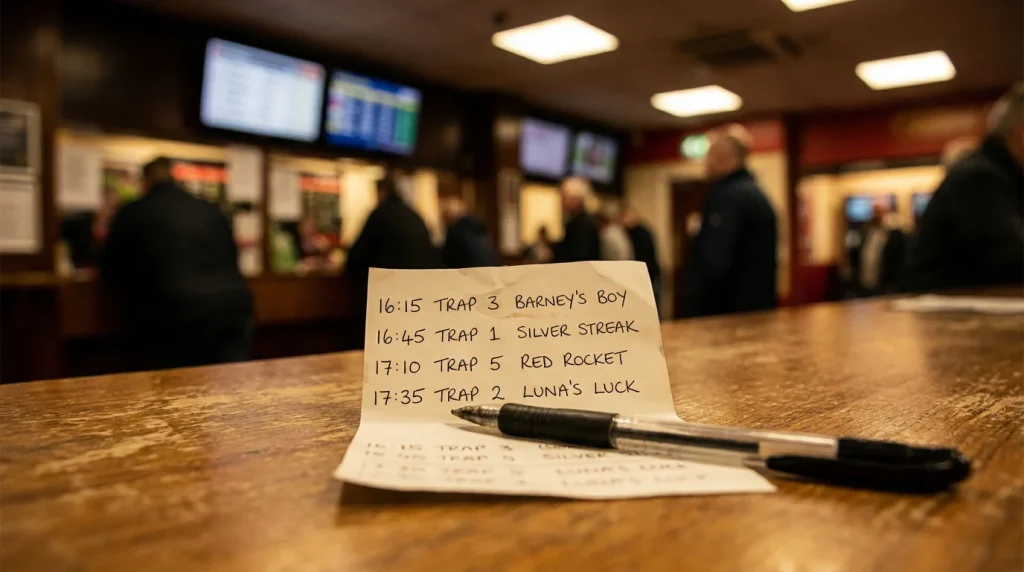
Accumulator bets on greyhound racing are placed by adding selections to your betslip and choosing “accumulator” from the available bet types. Most bookmakers will let you combine selections from different meetings, so you can include a 7pm pick from Romford, a 7:15 from Hove, and an 8pm from Monmore in the same acca. However, you generally cannot include two selections from the same race in a standard accumulator — for that, you would need a forecast or tricast.
If one leg of the accumulator is a non-runner, most bookmakers treat that leg as a winner at 1/1 (evens), reducing the accumulator by one leg. So a four-fold with one non-runner becomes a treble. The potential payout decreases, but the bet survives. If more than one leg is voided, the accumulator shrinks further. Always check your bookmaker’s non-runner rules, as some platforms handle this differently.
Cash out is widely available on greyhound accumulators. If your first two legs have won and the third is about to race, you can cash out for a guaranteed profit before the third race runs. The cash-out value reflects the remaining legs’ odds and the bookmaker’s margin. This feature turns accumulators into a more flexible instrument — you are not locked into an all-or-nothing outcome unless you choose to be.
Forecast and Tricast Doubles
Beyond standard win accumulators, greyhound betting allows you to build multiples from forecast and tricast bets. A forecast double combines two straight forecasts from different races into a single accumulator. Both forecasts must land for the bet to pay. The returns can be spectacular — two forecast dividends compounding on each other produce payouts that dwarf anything a standard win acca can deliver.
Here is how it works. You place a straight forecast on the 7pm race at Romford and a straight forecast on the 7:15 at Hove. Both are linked as a double. If the first forecast pays a £25 dividend to a £1 stake, that £25 rolls onto the second forecast. If the second also lands at a £30 dividend, the total return is £750 from a £1 stake. The compounding effect is enormous because each individual forecast dividend already reflects the difficulty of naming the first two in order.
Tricast doubles work identically but with tricast bets as the legs. The potential returns are astronomical — it is entirely possible for a £1 tricast double to return four or even five figures if both tricasts involve at least one longer-priced finisher. The probability of landing such a bet, however, is vanishingly small. In a six-runner field, the chance of a straight tricast landing is roughly 1 in 120. The chance of two consecutive straight tricasts landing is 1 in 14,400. These are lottery-adjacent numbers.
Some bettors build mixed multiples — a win selection on one race linked to a forecast on another, or a forecast linked to a tricast. These hybrid accumulators offer a middle ground between the achievable (win doubles) and the improbable (tricast doubles). A win-and-forecast double might have one leg with a 25% chance and another with a 3% chance, producing a combined probability of about 0.75% — long, but not absurd for the returns on offer.
The Realistic Strike Rate
The fundamental problem with greyhound accumulators is that the strike rate collapses exponentially with each additional leg. A single win bet on a greyhound at 3/1 has roughly a 25% chance of success. Acceptable. A double at the same odds has a 6.25% chance. Manageable. A treble drops to 1.56%. A four-fold to 0.39%. A five-fold to 0.1%. By the time you reach a six-fold, the probability is around one in four thousand.
These numbers assume you are picking selections with a 25% win probability — which implies moderate favourites or near-favourites. If you are building accumulators from longer-priced dogs, the strike rate drops further. And if your selection method is not producing winners at the expected rate — if you are picking 25% shots that actually win only 20% of the time — the cumulative effect across multiple legs makes the accumulator significantly worse than its theoretical payout suggests.
The bookmaker’s margin compounds across legs too. In a single bet, the overround might cost you 5-10% in expected value. In a four-fold, that margin applies to every leg, so the total expected-value drag is substantially larger. This is why bookmakers love accumulators: the built-in margin multiplies with the number of legs, making multi-leg bets the highest-margin product in the book.
None of this means you should never place an accumulator. It means you should do it with clear-eyed awareness of the probability involved. A £2 treble on a Saturday evening for entertainment is perfectly reasonable. A £50 five-fold as a serious attempt to make money is not a strategy — it is a lottery purchase dressed up as a betting decision.
Fun Money, Not Rent Money
The honest advice on greyhound accumulators is this: use them for entertainment, stake small, and expect to lose most of them. The few that land will be memorable. The many that fail will be forgettable — provided the stakes were low enough that each loss was trivial.
A reasonable approach is to allocate a fixed percentage of your weekly betting bankroll to accumulators — say, 5-10% — and treat it as your entertainment fund. The rest of your bankroll goes on singles, each way bets, and forecasts where the edge is sharper and the variance is lower. This way, you get the thrill of the acca without the financial exposure that makes a losing streak painful.
Build your accas with thought, not just enthusiasm. Select races where you have a strong opinion, not races you are including just to add legs. Three confident selections in a treble are better than six speculative ones in a six-fold. Use cash-out when two of three legs have landed and the third is uncertain. And never chase a losing acca by placing another, larger one. The maths does not care about your frustration. It just keeps compounding against you.