Greyhound Derby Betting Guide — Odds, History and Tips
Best Greyhound Betting Sites – Bet on Greyhounds in 2026
Loading...
The Race That Stops the Dog World
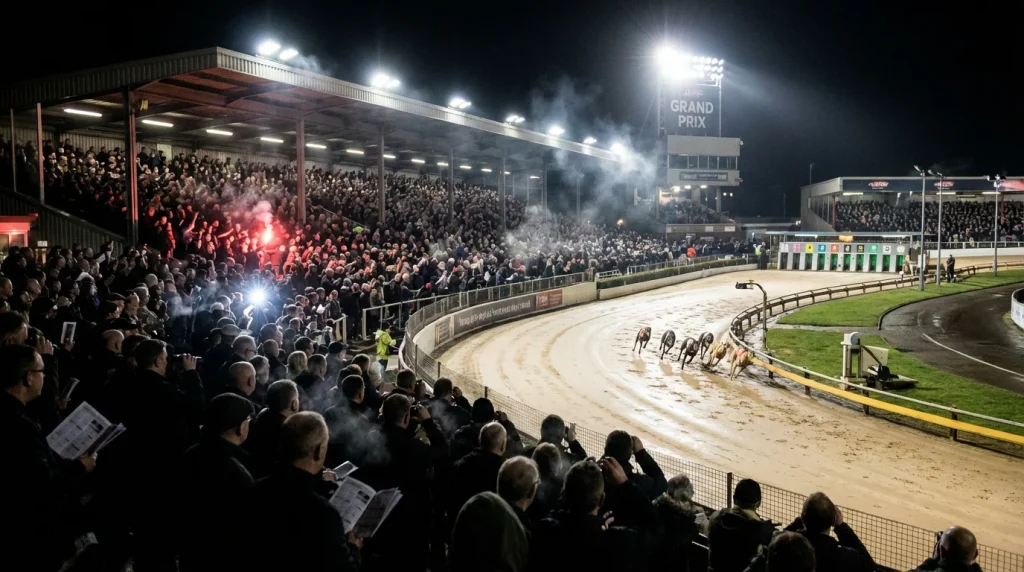
The English Greyhound Derby is the single biggest event in British greyhound racing. It has been run since 1927, has produced legends of the sport, and generates more betting interest than every other greyhound race combined. For one night in late June or early July, greyhound racing steps out of the afternoon BAGS card and the evening RPGTV slot and becomes a genuine national sporting occasion — covered by mainstream media, watched by casual fans who normally ignore the dogs, and bet on by punters who treat it as their annual flutter on the sport.
The Derby is run over the standard distance at its host venue, with six finalists competing after several weeks of heats and semi-finals. The competition format is a knockout — lose and you are out — which means the six dogs in the final have proven their ability across multiple rounds against high-quality opposition. It is the closest greyhound racing comes to a championship, and the final is the closest it comes to a cup final.
For bettors, the Derby offers something that ordinary greyhound meetings cannot: a deep, liquid ante-post market, extensive form data across the competition rounds, and a final that is arguably the most analysable single race on the greyhound calendar. This guide covers the event’s history, the betting markets available, and the trends worth knowing before you place your Derby wager.
History and Format of the Greyhound Derby
The first Greyhound Derby was run in 1927 at White City Stadium in London. Entry Badge won at odds of 1/4 favourite in front of a crowd that established greyhound racing as a mass-participation spectator sport in Britain. Through the following decades, the Derby became the defining race in the sport, with winners like Mick the Miller in 1929 and 1930 achieving a level of public fame that no greyhound has matched since.
The event moved venues several times as stadiums closed. White City hosted it until 1984. Wimbledon took over in 1985 and held it until 2016, with the stadium closing permanently in March 2017. Towcester briefly hosted the race before its financial difficulties intervened, and Nottingham stepped in for 2019. The Derby returned to Towcester after the track reopened in 2021 and has been held there since. The competition format, however, has remained broadly consistent: an entry of nominated dogs, whittled down through rounds of heats and semi-finals to a six-dog final.
A typical modern Derby begins with several dozen entries. Dogs are seeded into heats based on their recent form and grading, and each heat is a competitive race over the standard distance. The fastest or most impressive performers advance to the next round. Semi-finals reduce the field further, and the six surviving dogs contest the final. The entire competition spans three to four weeks, meaning a Derby finalist has run at least three intense races in quick succession — a test of both ability and durability.
The prize money for the Derby final is the largest in UK greyhound racing — the winner’s purse stands at £175,000 — though modest by comparison with horse racing’s marquee events. The winner’s purse, sponsor bonuses, and associated prizes make it the single most valuable night in a greyhound’s career. For trainers and owners, a Derby win is the pinnacle of the sport — the achievement that defines a career.
Betting Markets for the Derby
The Derby generates betting markets that are unavailable for standard greyhound meetings. The most distinctive is the ante-post market, which opens weeks before the competition and updates as the rounds progress. Ante-post Derby betting allows you to back a dog at long odds before the final field is known, accepting the risk that your selection might be eliminated in the heats.
Ante-post prices for the Derby are significantly longer than the race-night prices. A dog available at 16/1 in the ante-post market before the first heat might be 3/1 by the time it reaches the final — if it reaches the final. The contraction in odds reflects the reduction in uncertainty as weaker dogs are eliminated and the field narrows. Bettors who identify the eventual winner early enough to take the ante-post price can secure returns that are multiples of what race-night bettors receive.
Once the final six are declared, the market shifts to standard pre-race betting. Win, place, each way, forecast, and tricast bets are all available. The Derby final typically attracts sharper money and tighter margins than a regular race, meaning the odds are more efficient and value is harder to find. Best Odds Guaranteed — where available — is particularly useful for the Derby final, as the market can shift substantially between the morning prices and the evening off.
Forecast and tricast betting on the Derby final is popular because the six-dog field is compact enough to analyse thoroughly. Bettors have weeks of competition form to study — trap times, running styles, response to pressure, recovery between rounds — and this depth of information makes the first-second-third prediction more structured than in a random Tuesday evening race. Derby forecasts and tricasts often carry smaller dividends than equivalent bets on lower-grade racing because the market is better informed, but the analytical satisfaction of landing one is considerably greater.
Past Winners and Trends
Derby winners tend to share certain characteristics. The most consistent trend is early pace. Dogs that reach the first bend in front have won the majority of Derby finals throughout the race’s history. The pressure of a final — six high-quality dogs running at peak effort — rewards the dog that establishes a clear lead early and does not have to navigate traffic. Front-runners with inside draws have the strongest historical record in the final.
Trap 1 and trap 2 have produced more Derby winners than the outside traps. This reflects the first-bend advantage that inside draws provide at most UK tracks, amplified by the intensity of the final where every dog is running at or near its best. A slow-starting dog drawn in trap 5 or 6 faces a tougher challenge in a Derby final than in a Tuesday evening A3, because the field is faster and the margin for recovery is smaller.
Trainer patterns are worth noting. Certain kennels — historically those with the largest and most professionally managed operations — appear disproportionately in Derby finals. Trainers who know how to peak a dog’s form across a multi-week competition have a structural advantage over those who bring a dog in brilliant condition for the first heat but cannot sustain that form through subsequent rounds. If a trainer has reached the Derby final three or four times in the past decade, that track record is meaningful data, not coincidence.
Age is another factor. Derby winners are overwhelmingly dogs in their prime racing years — typically between two and three-and-a-half years old. Younger dogs may lack the experience to handle the intensity of a knockout competition. Older dogs may not have the peak speed to compete with younger rivals at the highest level. The sweet spot is a dog that has been racing long enough to be seasoned but is still physically at its sharpest.
One trend that is sometimes overstated is the importance of the semi-final performance. A dog that wins its semi-final impressively is an obvious contender, but some Derby winners have scraped through the semis and then produced their best performance in the final. The semi-final result tells you the dog is good enough to be there; it does not tell you whether it will peak on the night that matters most.
The Race That Defines the Year
The Derby is greyhound racing distilled to a single evening. Six of the best dogs in the country, trained and prepared over weeks, competing for the sport’s most prestigious title over a distance that takes less than thirty seconds to cover. The ante-post market opens months in advance. The betting volume on the final exceeds any other night in the greyhound calendar. And the result — for one night — actually makes the news.
For the bettor, the Derby offers the deepest pool of data, the most liquid market, and the highest-profile result of the year. Whether you back a dog ante-post in March or place a forecast on the night of the final, the Derby rewards preparation and punishes guesswork. Study the heats. Track the form through each round. Note the trap draws, the sectional times, the running styles. By the time the six dogs load into the traps for the final, you should know each one well enough to have a genuine, evidence-based opinion on who wins — and who fills the places.