
Weather and Track Conditions in Greyhound Racing
 Available in US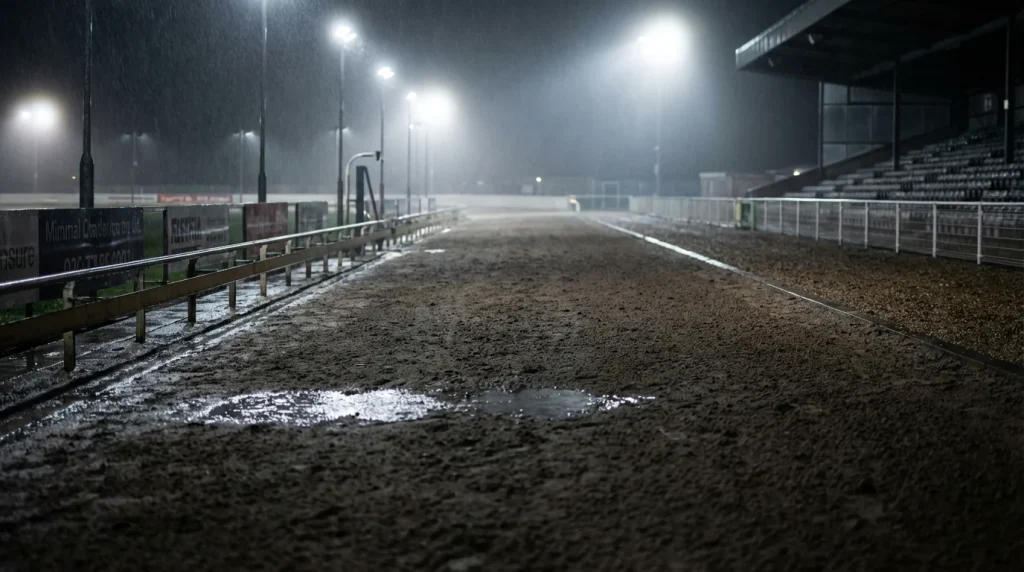
The Variable That Most Bettors Forget to Check
Greyhound bettors study the form. They check the trap draw. They compare the odds. And then they ignore the weather, which can invalidate everything they have just analysed. Greyhound races are run on sand, outdoors, under whatever the British climate decides to deliver on any given evening. Rain makes the surface heavier. Wind affects the dogs down the home straight. Temperature shifts change how the sand behaves underfoot. These are not marginal effects — on a wet night, the fastest dog on a dry surface may not be the fastest dog in the race.
Track conditions in greyhound racing do not receive the same formal reporting as in horse racing, where the “going” is officially declared and published before every meeting. There is no equivalent of “Good to Firm” or “Heavy” on the greyhound card. But the impact of conditions is just as real, and the bettor who factors weather into their analysis has an edge over the majority who do not bother.
This guide covers how rain, wind, and temperature affect greyhound racing, and how to adjust your betting when conditions deviate from the dry, still, mild evenings where form figures are most reliable.
How Rain Affects Sand Tracks
Rain is the most significant weather variable in UK greyhound racing. Every licensed track in the country uses a sand surface, and sand behaves very differently when it is saturated. Dry sand is loose and light — it gives way under the dog’s feet, absorbing some energy but allowing quick acceleration and sharp turning. Wet sand is heavier, more compact, and more demanding to run through. It creates a surface that punishes lighter dogs and rewards physical strength.
When rain falls steadily before or during a meeting, the track times slow. A standard-distance race that typically produces a 29.50-second winning time on dry sand might run at 29.90 or 30.10 in wet conditions. The slowdown is not uniform across the field — heavier, more powerful dogs are less affected than lighter, speedier types. This is because the additional resistance of the wet surface favours muscle mass over acceleration. A lighter dog that wins on dry sand by being quick out of the traps may lose that advantage when the surface demands more effort with every stride.
The effect on bending is notable too. Wet sand provides less grip, which means dogs that rely on tight cornering — inside runners that hug the rail through bends — can lose traction and drift wider. A dog that consistently takes the rail on dry sand might run a wider line on a wet track, losing the ground advantage that its racing style normally provides. Conversely, dogs that run wide naturally are less affected because they are already taking a broader line and not relying on tight grip through the bends.
Drainage varies between tracks. Some venues drain quickly and return to near-normal conditions within an hour of rain stopping. Others hold water longer, particularly older tracks with less advanced surface maintenance. If rain fell during the afternoon but stopped two hours before the evening meeting, the track may be damp but not heavy. If rain is still falling at race time, expect significant time slowdowns and a surface that favours the stronger physical types.
Checking the weather forecast before a meeting is a thirty-second task that most bettors skip. A quick glance at the Met Office or BBC Weather for the track’s location tells you whether rain is expected. If it is, review your selections through the lens of which dogs handle wet conditions — and which form figures were recorded on dry evenings that may not replicate tonight.
Wind, Temperature and Surface
Wind is the second-most impactful weather condition, and its effect is straightforward: headwinds slow the dogs down the home straight, and crosswinds can push dogs off their running line. UK greyhound tracks are not shielded from wind — they are open venues, often in exposed locations — and a strong wind can add half a second to finishing times.
The home straight is where wind matters most. Dogs running into a headwind in the final 100 metres tire faster, and front-runners who have been leading the entire race are most vulnerable because they have been working hardest for longest. Closers — dogs that sit behind the pace and finish strongly — can benefit in windy conditions because the leaders do the work of breaking the wind while the trailing dogs draft behind them. On a gusty evening, look more favourably at closers and less favourably at confirmed front-runners.
Temperature affects the sand surface indirectly. On hot days — rare in the UK, but not unheard of during summer meetings — the sand dries out faster and can become very loose, which slows times and increases energy expenditure. Cold temperatures in winter can make the sand firmer, especially if there has been a frost. A frozen or semi-frozen surface is faster but also harder on the dogs’ joints and muscles, and meetings may be abandoned if the track is deemed unsafe.
Seasonal variation in surface quality is something experienced bettors factor into their long-term form analysis. A dog’s times in mid-summer, when the track is dry and loose, are not directly comparable to its times in November, when the sand is wet and heavy. Speed ratings attempt to adjust for this, but they cannot capture every nuance. Being aware that a time recorded in January probably ran on a heavier surface than one recorded in June adds a useful layer of context to form reading.
Adjusting Bets for Conditions
The practical application of weather analysis is not complicated. It requires three steps: check the forecast, identify the conditions, and reassess your selections accordingly.
On wet nights, favour dogs with physical strength and proven ability to handle heavy ground. Check whether a dog has raced in wet conditions before and how its times compared to its dry-surface performances. A dog that slows by only 0.2 seconds on a wet track — when the average slowdown is 0.5 seconds — handles the conditions well. A dog that slows by 0.8 seconds is struggling. This data is available in the form guide: cross-reference recent times with the weather on the race dates.
On windy evenings, downgrade front-runners racing into a headwind on the home straight and upgrade closers who can draft and finish. Consider each-way bets on confirmed closers at longer odds — the conditions give them a structural advantage that the market may not fully price in, particularly at BAGS meetings where market efficiency is lower.
On dry, still evenings — the default condition for most UK greyhound meetings — the form guide is at its most reliable. Times recorded on similar dry evenings are directly comparable, and the fastest dog on paper is more likely to be the fastest dog on the track. These are the nights where standard form analysis works best and weather adjustment is unnecessary.
Weight data in the form guide provides a secondary weather indicator. Heavier dogs — those at the upper end of the weight range for their grade — are typically better suited to wet conditions because their mass helps them power through resistant sand. Lighter dogs excel in dry conditions where speed and agility matter more than raw power. If the track is wet and you are choosing between two closely matched dogs, the heavier one has a physical advantage that the form figures alone will not show.
One additional consideration is whether a meeting is likely to produce non-runners due to conditions. Some trainers withdraw dogs from meetings on very wet or cold nights to protect their animals. A late non-runner can reshape the market — Rule 4 deductions apply, odds shift, and the race dynamic changes with fewer dogs. Always check the final declarations close to race time, especially on nights with adverse weather.
Check the Forecast Before You Check the Form
British weather is unpredictable, but it is not unknowable. A five-day forecast gives you a reasonable idea of what to expect on race night. A same-day forecast gives you something close to certainty. Incorporating that information into your greyhound analysis costs nothing — no subscription, no data feed, no specialist tool. Just check the weather for the track’s location and ask a simple question: will tonight’s conditions match the conditions in which my dog’s form was recorded?
If the answer is yes, the form guide serves you well. If the answer is no — if rain is expected and the form was recorded on bone-dry sand, or if a gale is forecast and the dog is a front-runner who leads on the rail — then the form guide needs recalibrating. The numbers do not change. The context they were recorded in does. The bettor who recognises that distinction bets with more information than the one who treats every night as identical.
Get more race analysis at greyhoundlivestream.
Also read our greyhound trap draw bias.
