
Greyhound Ante-Post Betting — Early Odds and Risks
 Available in US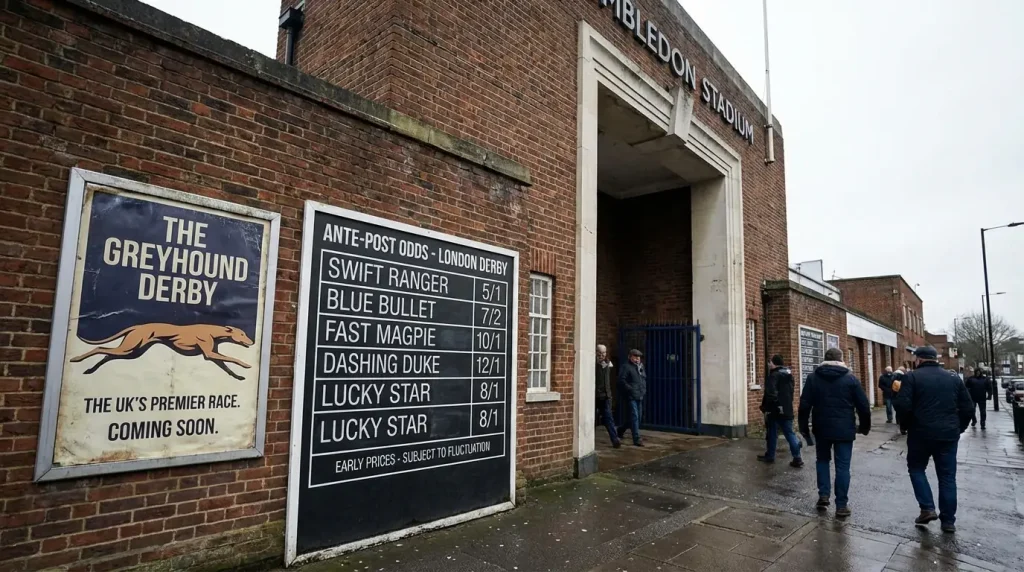
Betting Before the Race Exists
Ante-post betting is placing a wager on an event before the final field is confirmed. In greyhound racing, this usually means betting on a major competition — the English Greyhound Derby, the St Leger, the Puppy Derby — weeks or even months before the final takes place. You are backing a dog to win a race that, at the time of your bet, may not even have completed its opening heats.
The appeal is price. Ante-post odds are longer than the prices available on race day because they incorporate the additional uncertainty of whether the dog will make it to the final, stay injury-free, maintain form through the rounds, and draw a favourable trap. Bookmakers know that a significant percentage of ante-post bets will lose not because the dog was beaten on the night, but because it never got to the night — knocked out in an earlier round, withdrawn through injury, or simply not entered. That risk is priced into the odds, which is why ante-post favourites for the Greyhound Derby might be 8/1 or 10/1 when they would be 2/1 or 3/1 on the night of the final.
Ante-post greyhound betting occupies a narrow niche. It applies only to the sport’s biggest events, and the market is far thinner than ante-post horse racing. But for bettors willing to accept the risk, it offers the chance to lock in value that evaporates once the final field is known.
What Ante-Post Means
The term comes from the Latin “ante” — before — combined with “post,” referring to the starting post. It literally means betting before the start, though in modern usage it means betting before the final declarations. In greyhound racing, ante-post markets typically open weeks before a major competition begins and close once the final runners are declared.
The key distinction between ante-post and standard pre-race betting is the non-runner rule. In a standard greyhound race, if your dog is withdrawn before the off, your bet is void and your stake is returned. In ante-post betting, if your dog does not make the final — for any reason — your stake is lost. No refund. No Rule 4 deduction. The bet is settled as a loser. This is the central risk of ante-post, and it must be understood before a penny is staked.
Bookmakers open ante-post markets for the Greyhound Derby as early as several months before the competition, often when trainers nominate their entries. Initial prices are based on previous racing form, trainer reputation, and kennel assessments. As heats progress and dogs are eliminated, the market reshapes. Dogs that win their heats impressively shorten. Dogs that scrape through or look below par drift. Dogs that are eliminated leave the market entirely — and any ante-post money on them is gone.
The ante-post market for greyhound racing is smaller than for horse racing equivalents like the Grand National or the Cheltenham Gold Cup. Fewer bookmakers price it, the betting limits are lower, and the available information is sparser. This can work in the bettor’s favour: smaller markets are less efficient, meaning genuine value is more likely to persist because fewer sharp bettors are targeting it.
Risks — Non-Runners and Lost Stakes
The non-runner risk is not hypothetical. It is the defining feature of ante-post betting and the reason the odds are attractive. In the Greyhound Derby, dozens of dogs are nominated for the early rounds. Only six make the final. Every dog eliminated along the way takes ante-post money down with it.
Injuries are the most common cause of ante-post losses. Greyhounds are athletes running at high speed on sand, and muscular injuries — pulled muscles, strained ligaments, foot problems — are a routine part of the sport. A dog can look like a Derby contender one week and be ruled out the next. There is no advance warning, no fitness update published to the market. You find out when the dog does not appear on the card for the next round.
Elimination through competition is the other major risk. A dog might be fully fit but simply lose in a heat or semi-final. Greyhound racing is unpredictable at the best of times, and in a knockout competition, a single bad break from the traps or a bump at the first bend can end a campaign. The ante-post bettor has no control over draw or in-race incidents, and these variables are magnified across multiple rounds.
Trap draw in the final is also a consideration that ante-post bettors must accept blind. You do not know which trap your dog will draw when you place the ante-post bet. A dog drawn in trap 1 for the Derby final has a materially different chance of winning than the same dog drawn in trap 6. This trap uncertainty is part of what the ante-post price compensates for, but it means you could have the right dog at the wrong price if the draw falls unfavourably.
There is also the less common but real risk of a dog being sold, retired, or re-routed to a different competition between the time of your bet and the final. Ownership changes are not unheard of in greyhound racing, and a change of trainer or a decision to target a different event can make your ante-post bet worthless even if the dog is perfectly healthy.
Finding Value in Early Markets
Despite the risks, ante-post betting exists because it offers prices that are unavailable once the final field is known. The question is how to identify which ante-post bets represent genuine value rather than just a long price on a hopeful selection.
The first criterion is class. In major competitions, the highest-graded dogs with the best track records through the season are the most likely to navigate the rounds and reach the final. Backing a well-established A1 performer ante-post is inherently less risky than backing an unproven A3 dog that would need to produce career-best form just to survive the heats. The price on the A1 dog will be shorter, but its probability of reaching the final is significantly higher, which means the risk-adjusted value may be better than the headline odds suggest.
Trainer record in the specific competition matters. Certain trainers consistently prepare their dogs for the big events, peaking their form at the right time and managing the workload across multiple rounds. A trainer with a history of Derby finalists is a safer bet — not because the dog is guaranteed to win, but because the campaign management reduces the risk of the dog being withdrawn or underperforming due to poor preparation.
The timing of your bet affects the value you receive. Prices are longest when the market first opens and progressively shorten as the competition unfolds and the field narrows. Betting earliest gets you the best price but the highest non-runner risk. Betting after the first round reduces the field risk but costs you the early-round price advantage. A reasonable compromise is to bet after the first round of heats, when you have seen the dogs run in the competition environment and the weakest have been eliminated, but before the semi-finals when the market tightens dramatically.
Staking discipline is critical in ante-post. Because a significant percentage of bets will be lost to non-runners, your unit stakes should be smaller than for standard race-day betting. A common approach is to stake half your usual unit on ante-post selections, accepting that the longer odds compensate for the higher frequency of total losses. If your standard win bet is £10, an ante-post bet of £5 at double the odds delivers similar potential returns with appropriate risk calibration.
Patience Has a Price Tag
Ante-post greyhound betting is a waiting game. You place your money weeks before the result, and in the interim you watch heats, check results, and hope your dog stays healthy and keeps winning. There is no cash-out option on most ante-post markets. Once the bet is placed, it sits there until the final or until your dog is eliminated.
That patience is the price you pay for odds that would be half the length on the night of the final. Whether the exchange is worthwhile depends on your tolerance for total-loss risk and your ability to identify the dogs most likely to survive the journey from entry to final. It is not for every bettor. The casual punter who enjoys a £5 win bet on tonight’s 7:30 at Romford will find ante-post betting stressful and unintuitive.
But for the bettor who follows greyhound racing closely enough to assess a dog’s trajectory through a season, who understands the competition format, and who is comfortable tying up stakes for weeks, ante-post markets offer something the nightly card cannot: the chance to be right before the crowd even starts looking.
Find more strategy guides at greyhoundlivestream.
Also read our greyhound derby betting guide.
