
Greyhound Live Betting — In-Play Markets and Strategy
 Available in US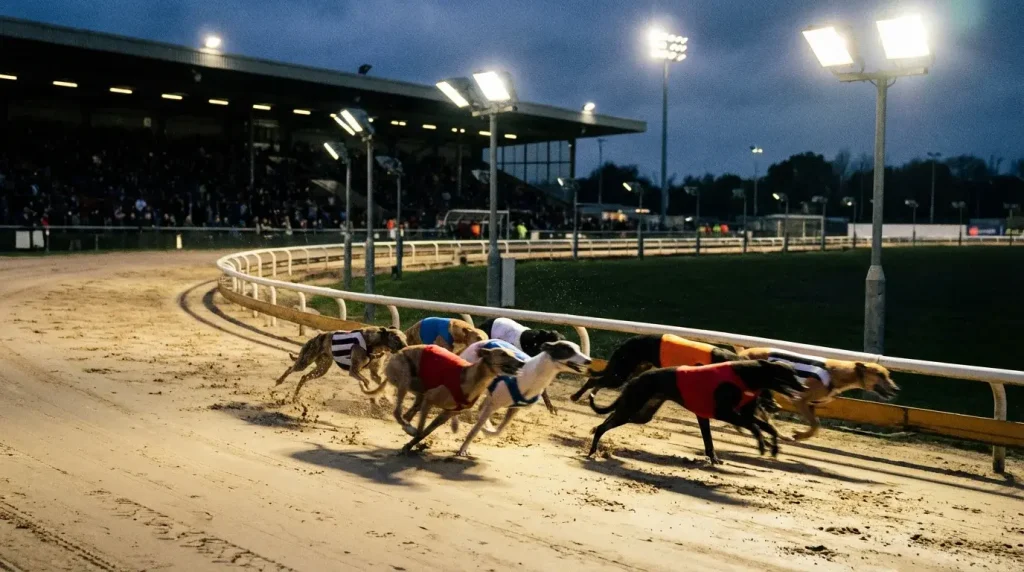
Betting While the Hare Is Running
A greyhound race lasts about thirty seconds. From the moment the traps open to the moment the first dog crosses the line, half a minute passes. In that window, in-play betting asks you to process visual information, assess changing probabilities, and place a bet — all while six dogs are sprinting at close to 40 miles per hour around a track that might be 380 metres in circumference. It is the fastest form of live betting available in the UK, and it is not for everyone.
In-play greyhound betting exists on a handful of platforms, and its availability has expanded as live streaming and low-latency data feeds have improved. The concept is the same as in-play betting on football or tennis: the odds update in real time based on what is happening in the event, and you can place a bet after the race has started. The difference is speed. In football, you have ninety minutes to read the game and find an entry point. In greyhound racing, you have the time it takes a dog to run two bends and a home straight. The margin for analysis is measured in seconds.
This article covers how in-play greyhound markets work, what bet types are available, and whether there is a realistic strategy for making live wagers on a sport that barely gives you time to blink.
How In-Play Greyhound Markets Work
In-play greyhound markets are powered by the same live data feeds that drive bookmaker streaming services. The market opens when the traps open — or in some cases, a few seconds before the off — and closes when the race finishes. During that window, the odds on each dog update continuously based on the race position and the time remaining.
The odds are generated algorithmically. No human trader is sitting at a desk adjusting prices during a thirty-second greyhound race. The system uses the live race feed, positional data, and pre-race pricing models to recalculate each dog’s win probability in real time. A dog that leads at the first bend will see its odds shorten dramatically. A dog that is last at the first bend will drift to long odds almost instantly. By the time the dogs enter the home straight, the market is usually heavily compressed: the leader is odds-on, the closest challenger is a short price, and everything else is double digits or effectively out of the market.
Latency is a critical factor. There is always a small delay between what is happening on the track and what your screen shows. The live stream you are watching runs a fraction of a second behind the actual race. The odds on your platform are calculated from data that is itself slightly delayed. This means that by the time you see a dog take the lead and decide to back it, the odds may have already adjusted. In practice, the window for placing an informed in-play bet on a greyhound race is extremely narrow — often just a few seconds at most.
Not all bookmakers offer in-play greyhound betting. The feature requires sophisticated low-latency infrastructure, and the risk management challenges of live pricing on a thirty-second event are significant. Among those that do offer it, the depth of the market varies. Some provide only win markets in-play. Others offer place betting as well. Forecast and tricast bets are generally not available in-play because the sequential nature of those bets requires all positions to be known, which only happens at the finish.
Bet acceptance is another consideration. In-play greyhound bets are often subject to a price confirmation delay. You click to place the bet, and the system checks whether the odds have changed since you made your selection. If they have moved significantly — which is likely, given how fast the market shifts — your bet may be rejected or you may be offered the new price. This adds another layer of friction to an already time-compressed process.
Available Live Bet Types
The in-play bet menu for greyhound racing is deliberately narrow. The speed of the event does not leave room for exotic markets, and most bookmakers restrict the live offering to the basics.
Win betting is the primary in-play market. You back a dog to win the race after the traps have opened. The odds change in real time as the field progresses around the track. The potential value in live win betting lies in the few seconds immediately after the traps open, when the market is still absorbing early-race information. A dog that breaks poorly from the traps but has a strong closing record might be available at inflated odds in the first five seconds of the race — longer than it deserves based on its true win probability — because the algorithm has reacted to its current position rather than its established running pattern.
Place betting in-play follows the same real-time pricing structure. You back a dog to finish in the top two, with the odds reflecting its current position and the system’s estimate of its place probability. Place markets in-play tend to be slightly more forgiving than win markets because you have two positions rather than one, but the same latency issues apply.
Cash out is the third in-play option, though it works in the opposite direction. If you placed a pre-race bet and your dog is leading at the first bend, the cash-out offer will reflect the increased probability of your bet winning. You can lock in a profit before the race finishes, reducing your exposure to the risk of the dog being caught in the home straight. Cash out during a live greyhound race is an exercise in rapid judgement: the offer updates every second, and deciding whether to take the money or let the race play out is a gut-level call that has to happen fast.
Some platforms also offer combined markets for in-play greyhound, though this is rare. The practical reality is that the event is too short for complex market structures. Win, place, and cash out are the tools you have. Everything else is better handled before the race starts.
In-Play Strategies
Calling it a strategy might be generous. In-play greyhound betting does not lend itself to the kind of structured, data-driven approach that works for pre-race betting. The timeframe is too short, the information flow is too fast, and the latency issues are too significant for systematic exploitation. That said, there are principles that separate thoughtful in-play bettors from people mashing the bet button in a panic.
The first principle is preparation. In-play betting should not be improvised. Before the traps open, have a clear view of the race: which dog is the likely leader, which dogs are closers, and what the race shape is likely to be. If the race unfolds differently from your expectation — the favourite misses the break, a wide runner gets a dream run on the rail — that unexpected scenario is where the in-play value lives. The algorithm reprices based on position. You, with your pre-race analysis, can assess whether the new position accurately reflects the dog’s remaining chances.
The second principle is selectivity. Do not attempt in-play bets on every race. Most races will play out exactly as the pre-race market predicted, and the in-play odds will offer no value. The races worth trading live are those where something unusual happens early: a strong favourite misses the break, two fancied dogs collide at the first bend, or a dog that was expected to lead is outpaced and drifts to big odds despite having a known finishing kick. These disruptions create temporary mispricings that evaporate within seconds.
The third principle is size control. In-play greyhound bets should be small. The speed of the event, the latency issues, and the compressed decision window all increase variance. Even well-judged live bets will lose frequently simply because the execution window is so tight. Betting small limits the damage on the inevitable misses and keeps the overall session manageable.
Cash out is arguably the most strategically sound in-play tool for greyhound racing. Rather than trying to enter the market after the traps open, you can use pre-race bets and then manage them live. If your pre-race selection leads at the first bend, the cash-out offer represents a risk-free profit that you can compare against the dog’s probability of holding on. For front-runners on tight tracks, where the probability of maintaining the lead is high, letting the bet run usually makes sense. For front-runners on wider tracks with a long home straight, where a closer might overtake, cashing out for a smaller guaranteed profit can be the more rational choice.
Thirty Seconds of Opportunity
In-play greyhound betting is a niche within a niche. It is not the core of any serious greyhound betting approach, and anyone who tells you they consistently profit from live greyhound wagers is either exceptionally skilled at rapid-fire decision-making or not telling the full story. The event is too fast, the latency is too real, and the algorithmic pricing is too efficient for most bettors to gain a meaningful edge during the race itself.
Where live betting does add value is in cash-out management and in the rare disruption trade — the race where the market gets it temporarily wrong because the algorithm reacts to position rather than underlying ability. Those moments exist. They are brief. They require preparation, speed, and discipline. And they require accepting that most of your in-play attempts will either miss the window or be rejected by the price-confirmation delay.
Treat in-play greyhound betting as a supplement, not a strategy. The real analytical work in greyhound racing is done before the traps open, when you have time to read the card, assess the form, and take a price with conviction. The thirty seconds after the traps are for watching, learning, and — occasionally — acting on a moment that the market has not yet fully priced.
Find more strategy guides at greyhoundlivestream.
Also read our greyhound racing betting guide.
