
Greyhound Trap Numbers and Colours — Quick Reference
 Available in US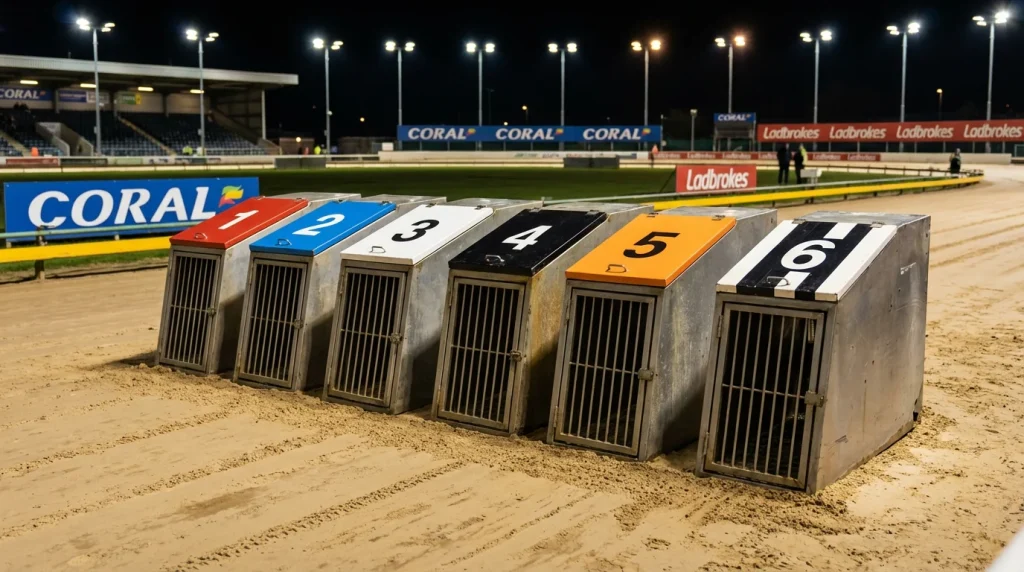
Six Traps, Six Jackets, Six Stories
Every greyhound race in the UK begins the same way: six dogs loaded into six numbered traps, each wearing a coloured jacket that matches their starting position. The colours are not decorative. They are the identification system for the entire race, from the moment the dogs enter the parade ring to the instant they cross the finish line. If you are watching on a live stream — especially on a small screen — the jacket colour is often the only reliable way to tell which dog is which once the traps open and six animals are sprinting at 40 miles per hour around a sand track.
The trap numbering system is universal across all licensed UK greyhound tracks under the Greyhound Board of Great Britain. Trap 1 is always on the inside rail. Trap 6 is always on the outside. The colours never change. Once you learn the six assignments, they apply at every track, every meeting, every race. It takes about thirty seconds to memorise them, and that thirty seconds pays for itself every time you watch a race.
But the trap is more than a starting position and a jacket colour. It defines the dog’s tactical situation for the entire race — particularly at the first bend, where most greyhound races are won and lost. Understanding what each trap position means, physically and strategically, is one of the foundations of informed greyhound betting.
The Six Traps and Their Colours
Here is the standard UK trap colour assignment:
| Trap | Colour | Position |
|---|---|---|
| 1 | Red | Inside rail |
| 2 | Blue | Second from inside |
| 3 | White | Centre inside |
| 4 | Black | Centre outside |
| 5 | Orange | Second from outside |
| 6 | Black and white stripes | Outside |
These colours are worn as jackets — lightweight fabric vests that fit over the dog’s body and are fastened before the dog enters the trap. The jackets are designed to be visible under floodlights and on camera, which is why the colours are bold and distinct. Red, blue, white, black, and orange are immediately recognisable in motion. Trap 6’s striped jacket stands out precisely because it is different from the solid colours.
On racecards, whether printed or digital, the trap colours are usually displayed as small coloured squares or circles next to the dog’s name. On live streams, commentators refer to dogs by both name and trap colour — “the red jacket on the inside” or “the stripes wide” — so knowing the assignments helps you follow the commentary as well as the visual action.
In some older literature, you might encounter references to a seventh or eighth trap. Historically, UK races once featured eight dogs, with trap 7 wearing green and trap 8 wearing yellow and black. These extra traps have been discontinued — both UK and Irish racing now run exclusively with six-dog fields, so you only need to know the six colours above.
Trap Draw and First Bend Advantage
The trap draw is not just a starting position. It determines the route a dog must take to the first bend, and in greyhound racing, the first bend is where races take shape. The dog that reaches the first bend in front — or at least in a favourable position on the rail — has a commanding advantage for the rest of the race. Dogs that get checked, crowded, or pushed wide at the first bend lose ground that is almost impossible to recover over a standard 480m trip.
Trap 1 has the shortest run to the rail. The dog in red starts closest to the inside and can take the first bend tight, saving ground on every other runner. For front-running dogs with quick early pace, trap 1 is the ideal position. The disadvantage is that trap 1 dogs can be squeezed if the dogs in traps 2 and 3 break fast and converge towards the rail.
Trap 2 is widely considered the most favourable draw at many UK tracks. The blue jacket has a clear line to the first bend without being pinned against the rail, and a fast-breaking trap 2 dog can slot into the lead or tuck in behind the trap 1 dog with minimal interference. At tracks with short runs to the first bend — Romford, Crayford, Swindon — trap 2 consistently produces the highest win percentage across all grade levels.
Traps 3 and 4, the centre positions, are more neutral. The dogs have neither the rail advantage of the inside traps nor the space of the outside. Their race depends heavily on the early pace of the dogs around them. A moderate-paced dog in trap 3 can easily get swallowed up by faster starters from traps 1 and 2 while also being squeezed by trap 4. Centre traps suit dogs with tactical speed — fast enough to avoid trouble but not necessarily the outright leader.
Trap 5 begins the outside territory. Orange jacket dogs have more room to run their own race without immediate crowding, but they cover more ground on every bend. A wide-running dog that likes to race on the outside can thrive from trap 5, provided it has the pace to hold position. The extra distance covered — perhaps two to three lengths per bend — means that a trap 5 winner has genuinely outrun the field, not just outmanoeuvred it.
Trap 6, the stripes, is the most polarising position. At some tracks, trap 6 is virtually a death sentence: the dog is so wide on the first bend that it cannot compete unless the inside runners interfere with each other. At other tracks — particularly those with long straights and generous bends — trap 6 is a viable position for strong, wide-running dogs that avoid the first-bend carnage entirely and pick off tiring leaders in the closing stages. The key is knowing the track.
Trap Bias by Track
Trap bias is real, measurable, and track-specific. Every UK greyhound venue has its own geometry — the length of the run from the traps to the first bend, the tightness of the bends, the camber of the track surface — and these physical characteristics create statistical advantages for certain trap positions.
At Romford, one of the UK’s most popular tracks, the run to the first bend from the 400m start is notoriously short. This compresses the field and gives inside traps — particularly trap 1 and trap 2 — a significant edge. Historical data shows trap 1 at Romford winning at roughly 22-24% across all grades, well above the 16.7% you would expect if all traps were equal. Trap 6 at Romford, by contrast, wins at closer to 10-12%.
Monmore Green offers a different profile. The bends are wider, the straights longer, and the run to the first bend is more generous. Trap bias at Monmore is less extreme than at Romford, though traps 1 and 2 still hold a modest advantage. Trap 5 and trap 6 perform relatively better here than at tighter circuits because the wider bends allow outside runners to maintain competitive positions without losing excessive ground.
Crayford, running at 380m for many of its races, is another tight-track venue where inside draws dominate sprint races. Nottingham and Hove sit somewhere in the middle — fair tracks where trap bias exists but does not overwhelm other form factors.
Where do you find this data? The Racing Post publishes trap statistics for every UK track, broken down by distance. Timeform includes trap-win percentages in its racecard data. Some bookmakers display basic trap stats on their coupon pages. The numbers change over time as track surfaces are resurfaced or remodelled, so check recent data rather than relying on figures from years past. A twelve-month sample is usually sufficient to identify meaningful bias at any venue.
The practical application is straightforward. Before placing a bet, check the trap statistics for the track and distance. If your selection is drawn in a trap that historically underperforms at that venue, factor that into your assessment. It does not mean you should never back an unfavourably drawn dog — class and form can overcome trap bias — but it does mean the dog needs to be better than the draw, not just competitive despite it.
The Jacket Tells a Story
Red, blue, white, black, orange, stripes. Six colours that define the structure of every greyhound race before it even starts. The jacket your dog wears is not just an identification marker — it is a positional statement that shapes the entire race dynamic.
Experienced bettors do not treat trap draw as an afterthought. They treat it as one of the three pillars of race analysis, alongside form and running style. A dog with brilliant recent form in a poor trap draw is not a certainty — it is a risk-adjusted proposition. A moderate dog in a perfect draw at a track that favours that position is not a surprise winner — it is a logical outcome.
Learn the six colours. Check the trap statistics at your preferred tracks. Factor the draw into every bet. The jacket is not just telling you where the dog starts. It is telling you how the race is likely to unfold.
Get more race analysis at greyhoundlivestream.
Also read our greyhound trap draw bias.
