
BAGS Greyhound Racing — What It Is and How to Bet
 Available in US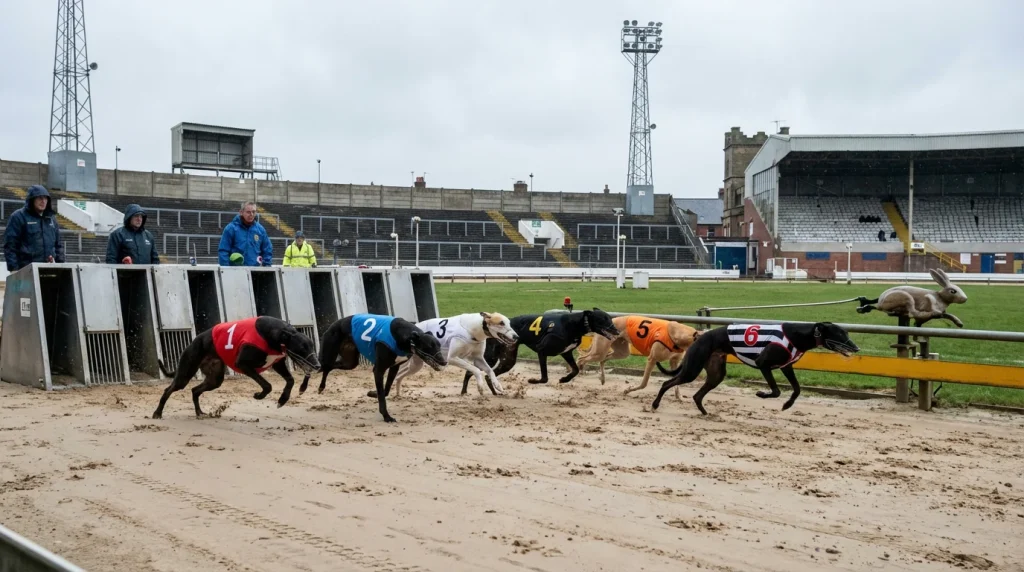
The Racing You Never Knew Was Running
Most people who bet on greyhound racing think of it as an evening activity — floodlit tracks, crowds at the rail, RPGTV commentary in the background. What they often miss is that the majority of UK greyhound racing actually takes place during the day, in near-empty stadiums, in front of nobody but the trainers, kennel staff, and the cameras that beam it to bookmaker platforms nationwide. This is BAGS racing, and it is the engine room of British greyhound betting.
BAGS stands for Bookmakers’ Afternoon Greyhound Service. The name is a holdover from its origin: a service created specifically to give betting shops a product to show during the daytime hours when horse racing is not running or between meetings. It was never designed for spectators. It was designed for screens. And in 2026, BAGS racing generates a significant share of the total greyhound betting turnover in the UK, running daily from late morning to early evening across a rotating roster of tracks.
If you are serious about greyhound betting, ignoring BAGS means ignoring the bulk of available races. The form data, the track conditions, the streaming access — it all runs through BAGS during the working day. Understanding how this service operates is not optional background knowledge. It is the foundation of any consistent greyhound betting approach.
What Is BAGS Racing
BAGS is a commercially funded racing programme organised under the auspices of the Greyhound Board of Great Britain. The service exists because bookmakers need a continuous supply of live betting events to offer their customers, and greyhound racing — with its fast turnaround between races and minimal operational overhead — fits that requirement better than almost any other sport.
A typical BAGS meeting features twelve races, each separated by roughly twelve to fifteen minutes. The meetings run at staggered start times so that there is almost always a race about to go off somewhere. On a busy afternoon, three or four BAGS meetings may run concurrently, meaning a bettor could be watching or wagering on a race every three to four minutes if they spread across tracks. The pace is relentless by design.
The tracks that host BAGS meetings are the licensed GBGB venues across England. Not every track runs BAGS every day — the calendar rotates — but venues like Crayford, Romford, Nottingham, Swindon, Doncaster, Kinsley, Yarmouth, Harlow, and Mildenhall appear frequently on the BAGS schedule. The race grades are typically A3 through A8, meaning you are watching competitive but not elite dogs. Open races and higher-grade fixtures tend to be reserved for evening or feature meetings.
From a regulatory standpoint, BAGS races are subject to the same GBGB rules as any other licensed meeting. Drug testing, welfare inspections, grading standards, and race officiating are identical. The difference is atmosphere, not governance. There are no spectators, no tote windows, no programme sellers. The races exist for the betting market, broadcast live to bookmaker platforms and available for streaming to anyone who meets the access requirements.
BAGS meetings are funded through a levy on bookmaker turnover generated by the racing. This commercial arrangement is what keeps the programme running seven days a week. Without it, many tracks would struggle to justify daily operations, and the supply of live greyhound betting content would shrink dramatically.
BAGS Tracks and Schedule
The BAGS schedule is published daily and is available on most bookmaker platforms as well as through the Racing Post and Timeform greyhound sections. Meetings are categorised by start time: the earliest fixtures begin around 11am, with the final BAGS race typically finishing by 5pm or 6pm before the evening programme takes over.
Track allocation rotates, but certain venues are BAGS staples. Crayford runs afternoon meetings frequently and is one of the most bet-on BAGS tracks. It is a tight circuit — 380 metres around — which tends to favour inside-drawn dogs and front-runners. Romford, one of the UK’s busiest tracks, hosts both BAGS daytime and premium evening cards, though its BAGS meetings tend to feature lower-grade races. Nottingham is a fair track that produces competitive racing across all grades. Swindon, Kinsley, and Yarmouth round out the regular rotation, each with their own character and biases that experienced bettors learn to account for.
The number of daily BAGS fixtures varies. Weekdays typically see three to four meetings; weekends may have more. Each meeting has twelve races, so on a standard Tuesday you might have thirty-six to forty-eight individual BAGS races to choose from. This volume is both an opportunity and a trap. The opportunity is obvious: more races means more chances to find value. The trap is equally obvious: more races means more temptation to bet on everything, which is the quickest path to an empty account.
One quirk of BAGS scheduling is that race times can shift by a few minutes to avoid clashing with races at other tracks. Bookmakers want to stagger the live product so bettors move smoothly from one race to the next. Check the actual off-times on your platform rather than relying on the published schedule, especially if you are placing bets close to the start.
Betting on BAGS Races
The betting markets for BAGS races are identical to evening meetings: win, place, each way, forecast, tricast, and combination bets are all available. The odds are set by the bookmakers’ trading desks and displayed on the racecard pages from the moment the card is published. Early prices are available on most BAGS races, and the market moves as money comes in throughout the morning and early afternoon.
One important characteristic of BAGS markets is that the overround — the bookmaker’s built-in margin — tends to be higher than for evening or feature meetings. This is partly because BAGS races attract less sharp money. The high-volume, rapid-fire nature of afternoon racing means the market is thinner, and bookmakers price accordingly. For the bettor, this means value can be harder to find in BAGS markets, but it also means that when you do find a mispriced dog, fewer other bettors are likely to have spotted it.
Live streaming for BAGS races is available through most UK bookmakers, though it usually requires a qualifying bet. The standard threshold is a £0.50 win or £0.25 each-way wager on the race you want to watch. Once placed, the stream unlocks. On some platforms, a single qualifying bet opens streaming for the entire BAGS session, letting you watch subsequent races without additional bets. Check your bookmaker’s specific streaming rules — they vary.
Form analysis for BAGS races follows the same principles as evening racing, but with a few practical adjustments. BAGS race grades tend to cluster in the middle range — A4 to A7 — so you are often comparing dogs of similar ability. Marginal advantages in trap draw, early pace, and track familiarity become more decisive than in open races where one dog might be vastly superior to the field. Pay close attention to recent form at the specific track. Dogs that have raced at the same venue within the past two weeks carry a track-fitness advantage that should not be underestimated.
Trainer patterns also matter. Some kennels are disproportionately successful at BAGS meetings because they specialise in the grade ranges that dominate the afternoon cards. A trainer with a 25% strike rate at Crayford BAGS meetings is a data point worth tracking, even if their overall record across all tracks is unremarkable.
The Afternoon Engine
BAGS racing does not have the glamour of a Greyhound Derby heat or a RPGTV-featured open race. It runs quietly, methodically, and relentlessly — twelve races at a time, three or four meetings per day, every day of the year. It is the infrastructure that keeps UK greyhound betting alive during daylight hours, and for many bettors, it is where the majority of their wagers are placed.
The lack of spectacle is actually an advantage for the analytical bettor. BAGS markets are less influenced by public sentiment and less likely to produce irrational favourite-backing than high-profile evening meetings. The data is there for anyone who wants it — form guides, sectional times, trainer records, trap statistics — and the races come thick and fast enough that a disciplined bettor can find genuine value across a single afternoon session.
Treat BAGS as a workplace, not a spectacle. The dogs are real, the data is real, and the money is real. The only thing missing is the crowd. For betting purposes, that might actually be a benefit.
Find more betting guides at greyhoundlivestream.
Also explore our greyhound racing tips and strategies.
