
How to Read a Greyhound Racecard
 Available in US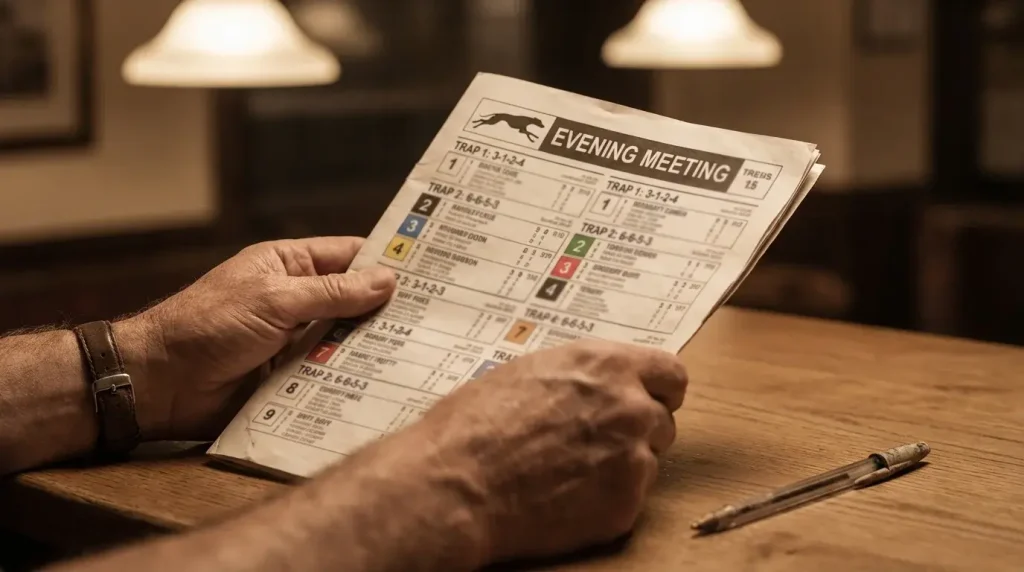
The Racecard Is Your Cheat Sheet
Everything the bookmaker knows is on the racecard — most bettors glance at it for five seconds. That is not an exaggeration. Watch a busy evening at any greyhound meeting, and you will see the majority of punters scanning the dog names, checking the odds, and placing a bet based on little more than gut feel or a favourite trap number. The racecard, meanwhile, sits right there on the screen, packed with data that would materially improve their chances.
A greyhound racecard is not complicated. It is not buried in jargon that requires a degree to unpack. But it does compress a lot of information into a compact format, and unless you know what each column and abbreviation means, it looks like noise. This is the guide that turns noise into signal.
Whether you are betting on the afternoon BAGS card or an evening RPGTV meeting, the racecard structure is essentially the same across every UK bookmaker and racing platform. Once you learn to read one, you can read them all. The fields might shift position slightly between platforms, but the data points are identical: trap number, dog name, trainer, form, times, weight, comments. Each one tells you something about the dog’s chances tonight. The trick is knowing which ones matter most, and how to read them quickly enough that you are not still analysing when the hare starts moving.
Anatomy of a Greyhound Racecard
Every racecard in UK greyhound racing is built from the same core components. Here is what you will see, working from left to right across a typical card.
Trap number and colour. The first column shows the dog’s starting position: trap 1 (red), trap 2 (blue), trap 3 (white), trap 4 (black), trap 5 (orange), trap 6 (black and white stripes). The trap number matters because it determines where the dog starts relative to the inside rail and the first bend. Trap 1 has the shortest run to the rail; trap 6 has the widest arc. In sprint races, where the first bend comes quickly after the traps, this distinction can decide the race.
Dog name and trainer. The dog’s registered racing name appears next, followed by the trainer’s name. Trainer information is more useful than most casual bettors realise. Certain kennels have strong records at specific tracks, and trainer form — how well their dogs have been performing over the past two or three weeks — can signal whether a dog is likely to be in peak condition.
Form figures. This is the sequence of numbers that appears alongside the dog’s name, typically showing the finishing positions from the last six runs. A form string of 111232 tells you this dog won three of its last six races and was competitive in the others. A string of 654600 tells a very different story. The numbers run from left (oldest) to right (most recent), so the rightmost figure reflects the dog’s latest performance. A zero usually indicates a non-finish — the dog was either knocked over, pulled up, or did not complete the race. Letters may appear too: M indicates a middle-distance race, S a sprint, H a hurdle.
Weight. Listed in kilograms, usually to one decimal place. On its own, a dog’s weight means little. What matters is the change from previous runs. A dog that has gained half a kilogram since its last race might be well-rested or slightly over-conditioned. A dog that has lost weight might be race-sharp — or undercooked. There is no universal rule, but consistent weight changes in one direction across several runs are worth noting.
Sectional and calculated times. Some racecards include sectional times — how long the dog took to reach the first bend, or how fast it covered the run-in. These are particularly useful for identifying early pace: a dog that consistently posts fast first-sectional times is a front-runner. Calculated times adjust the dog’s raw finishing time against the standard for its grade and track, giving a more meaningful comparison than raw clock readings. If a dog ran 29.50 seconds at Romford in an A3 race, the calculated time adjusts that figure so you can compare it against a dog that ran 29.65 at Monmore in an A4.
Comments in running. The final column on many racecards contains a brief comment from the previous race’s official observer. These are written in shorthand — we will cover the abbreviations in the next section — but they tell you what happened during the race. Did the dog lead early and fade? Was it bumped at the first bend? Did it finish strongly from the back of the field? These comments provide context that raw finishing positions cannot.
Racecard Abbreviations Decoded
BMP1, MSBK, RLRU — alphabet soup that tells a story. Greyhound racecards use a set of standard abbreviations in the comments-in-running column, and they appear on every card at every track. If you do not know what they mean, you are skipping the most descriptive part of the racecard.
Here are the abbreviations you will encounter most frequently:
| Abbreviation | Meaning |
|---|---|
| EP | Early pace — the dog showed speed from the traps |
| MSBK | Missed break — the dog was slow out of the traps |
| QAw | Quick away — fast start from the trap |
| SlAw | Slow away — poor start, not as severe as MSBK |
| BMP1 | Bumped at the first bend |
| BMP2 | Bumped at the second bend |
| RLS | Railed — ran close to the inside rail |
| RLRU | Railed on the run-up — close to the rail approaching the traps |
| W | Wide — ran wide, usually on a bend |
| CRD | Crowded — tight for room among other runners |
| LED | Led — was in front at some point during the race |
| FIN | Finished — how the dog ended the race, often paired with position |
| SAw | Steadied away — checked or slowed by interference |
| CHL | Challenged — mounted a challenge for a leading position |
| RAN ON | Strong finish — gained ground in the closing stages |
The real value of these abbreviations is in pattern recognition. A dog that has been marked BMP1 in three of its last four runs probably has a crowding problem at the first bend — and that problem is more likely to recur when it is drawn in a middle trap than when it has a clear inside or outside run. A dog consistently marked QAw or EP is a confirmed front-runner; put it in trap 1 or 2 on a short-run track and it becomes very dangerous. A dog that keeps showing RAN ON is a closer: it finishes strongly but needs the race to unfold in a certain way to get into contention.
Learning these abbreviations takes a few evenings of studying racecards alongside live races. Once they click, you will find that the comments column is often the most revealing part of the card.
Using the Racecard to Make Betting Decisions
Data in, decision out. The racecard gives you the raw material — the skill is in knowing which data points to prioritise for a given race and how to combine them into a betting judgement.
Start with the form figures. Identify which dogs are in current form — look for the most recent two or three runs showing finishes of first, second, or third. Dogs with consistent form across their last three outings are more reliable selections than those who won brilliantly three months ago but have been finishing mid-pack recently. Recency matters in greyhound racing because dogs’ conditions change quickly. A two-week layoff can mean anything from a refreshing break to a minor injury recovery.
Next, consider the trap draw in context. Look at which dogs are drawn inside versus outside, and check whether their running style suits their trap. A dog marked QAw and RLS in its recent comments wants the rail — if it is in trap 1 or 2, that is a natural advantage. The same dog drawn in trap 5 or 6 has to work harder to find the rail and may get caught up in traffic at the first bend. Conversely, a wide-running closer drawn in trap 6 has space to run its own race without getting squeezed.
Sectional times add another layer. Compare the first-bend sectional times of dogs in the same race to estimate the likely pace scenario. If three dogs all show fast early pace, there is going to be a battle for the lead — and a dog sitting just off that pace with a strong finishing kick could pick up the pieces. If only one dog has early pace and the rest are closers, the front-runner may steal the race unchallenged.
Weight changes are a tiebreaker. When two dogs look similarly matched on form and trap draw, a weight gain of 0.5kg or more since the last run might tip the assessment against the heavier dog, particularly in sprint races where speed off the mark is critical. It is not a decisive factor on its own, but in tight races, marginal differences matter.
Finally, check for first-time-at-track indicators. A dog running at a new venue for the first time has no track form to go on. It might handle the circuit brilliantly, or it might struggle with unfamiliar bends and distances. Unless you have strong evidence from similar-shaped tracks, treat first-time-at-venue dogs with caution — or use them as value opportunities if the market underestimates their ability.
Read It Once, Bet It Better
The racecard does not pick winners — but it eliminates losers. That distinction matters more than most bettors appreciate. In a six-dog field, if you can confidently rule out two dogs based on poor recent form, inappropriate trap draws, or repeated comments showing interference problems, you have narrowed the field to four. Your forecast or tricast combinations just became cheaper and more focused. Your win bet is now based on a genuine assessment rather than a coin flip.
The best racecard readers in greyhound betting are not geniuses. They are consistent. They read the same data points before every race, in the same order, and build a mental model of how the race is likely to unfold. It takes about sixty seconds per race once you know what you are looking at. That sixty seconds is the difference between betting with information and betting with hope.
Start with the form. Check the trap draw. Read the comments. Glance at the weight. Build a picture. Place the bet. The racecard gave you everything you needed — the least you can do is actually read it.
Find more form guides at greyhoundlivestream.
Also read our greyhound racing form guide.
