
Best Greyhound Betting Sites UK
 Available in US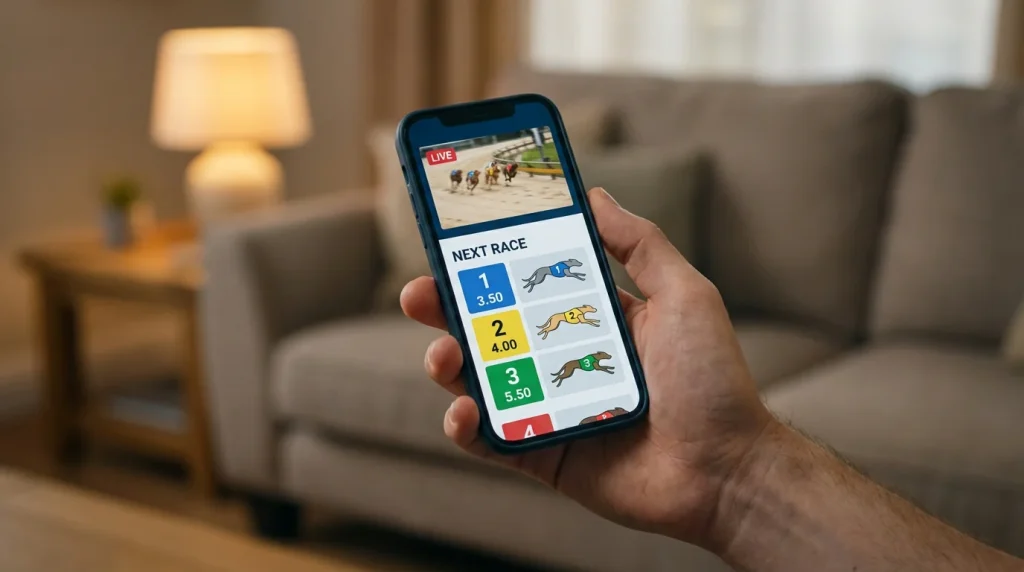
What Makes a Betting Site Good for Greyhound Racing
Most bookmakers list greyhound racing — far fewer build their platform around it. Open any major UK betting site and you’ll find greyhound markets somewhere in the sidebar, sandwiched between horse racing and virtuals. But listing the markets is the minimum. What separates a genuinely useful greyhound betting site from one that merely tolerates the sport is the infrastructure behind the odds: the quality of the live stream, the availability of form data, the depth of the market range, and the extras — Best Odds Guaranteed, dedicated promotions, in-app racecard tools — that make the experience smoother and more profitable.
This matters because greyhound betting is a high-frequency activity. Unlike football, where you might place one or two bets per match day, a typical greyhound session involves scanning multiple meetings, assessing form across dozens of races, and potentially placing several bets in a single evening. The platform you use becomes your workspace. If it’s slow, if the stream lags, if the form data is buried three taps deep in the app, you’re fighting the tool instead of using it. A good greyhound betting site should reduce the friction between your analysis and your bet placement to almost nothing.
This article doesn’t rank specific bookmakers — odds, features, and promotions change too frequently for a static ranking to remain accurate. Instead, it breaks down the criteria that matter, explains what to look for in each category, and gives you a framework for evaluating any bookmaker you’re considering. The goal is to make you a better shopper, not to hand you a recommendation that might be outdated by next month.
Key Features to Compare
Strip away the marketing and judge a bookmaker on these core features. They’re the foundation of a greyhound betting experience, and weaknesses here can’t be compensated by flashy promotions or welcome bonuses.
Live Streaming Quality and Access
Live streaming is the non-negotiable feature for serious greyhound bettors. Watching the race in real time — not just following the result — lets you observe how dogs break from the trap, how they handle the bends, and whether a loss was down to poor running or bad luck. That information feeds directly into future form analysis. A bookmaker that offers live streaming of greyhound racing is providing a research tool, not just entertainment.
Access terms vary. Some bookmakers require you to place a qualifying bet on the race to unlock the stream — typically as low as £0.50 on a win market. Others require only a funded account, meaning you can watch without betting on every race. The second model is significantly better for disciplined bettors who want to study the form and only act when they see value. Check whether the bookmaker streams BAGS meetings, RPGTV evening cards, or both — BAGS coverage is more common, while RPGTV availability depends on the bookmaker’s broadcast agreements.
Stream quality matters too. A 480p feed with a two-second delay is functionally useless for in-play observation. Look for bookmakers that provide stable, reasonably high-resolution streams with minimal latency. On mobile, the stream should load quickly and remain stable on a standard 4G connection. If the video cuts out every time you switch between the racecard and the live feed, the app isn’t designed for greyhound bettors.
Odds Competitiveness and BOG
Odds competitiveness is the most directly measurable criterion — and the one that affects your bottom line the most. A bookmaker that consistently prices greyhound markets a tick or two wider than competitors is costing you money on every bet, whether you notice it or not. Over a season of regular betting, the difference between a bookmaker offering 7/2 on your selection and one offering 3/1 on the same dog accumulates into a meaningful sum.
Comparing odds across bookmakers is straightforward: pick a race, note the prices at three or four sites, and see who consistently offers the longest price. Some bookmakers are more competitive on BAGS racing than on evening cards, or vice versa. The comparison doesn’t need to be exhaustive — a couple of weeks of spot-checking across different meeting types will give you a clear picture of where each bookmaker sits.
Best Odds Guaranteed — BOG — is the feature that amplifies odds competitiveness. When a bookmaker offers BOG on greyhounds, you take the early fixed price and if the Starting Price turns out to be higher, you’re paid at the better price. It’s a free upgrade that removes the risk of betting early. Not every bookmaker offers BOG on all greyhound meetings — some limit it to BAGS races, others extend it to evening cards. Check the terms carefully, because BOG availability is one of the clearest differentiators between a greyhound-friendly bookmaker and one that treats the sport as an afterthought.
Market Range and Track Coverage
A bookmaker that covers twenty UK tracks and ten Irish tracks gives you more opportunities than one that lists twelve UK tracks and ignores Ireland entirely. Market range matters because the more meetings you can access, the more selective you can be. If your analysis identifies a strong value bet at a BAGS meeting from Yarmouth but your bookmaker doesn’t list Yarmouth, that edge is wasted.
Beyond track coverage, check the range of bet types available. Every bookmaker offers win and each way markets. Forecast and tricast availability is standard but not universal for every race on every card. Combination forecasts and tricasts, trap challenge markets, and match bets are less consistently available — and these are often the markets where experienced punters find the best value. If your preferred bet type isn’t available at your current bookmaker, that’s a strong reason to consider an alternative.
Irish racing coverage is a useful litmus test. Bookmakers that stream and price Irish greyhound meetings are generally more committed to the sport than those that limit coverage to UK BAGS and evening cards. It signals that greyhound racing is a strategic priority for the site, not an afterthought.
Promotions, Stats and Tools
Free bets bring you in. Form tools and stats keep you. Promotions grab attention and they have real value when used correctly, but the features that genuinely improve your betting over the long term are the data tools — the form guides, the statistics, the racecard integrations that let you make better decisions without leaving the app.
Greyhound-Specific Promotions
The most common greyhound promotions across UK bookmakers follow a few standard patterns. Bet clubs offer a recurring free bet — often weekly — for customers who place a qualifying number of bets on greyhound racing. These are straightforward and generally worth using as long as the qualifying stakes align with your normal betting volume. Don’t increase your betting just to hit a bet club threshold; the free bet rarely compensates for the extra exposure.
Money-back specials — “money back if your dog finishes second” or “money back as a free bet if beaten by a length or less” — reduce the downside of near-misses and are particularly valuable on races where you’re considering an each way bet. Enhanced odds offers boost the price on selected greyhound races, typically limited to one per customer per race. These can offer genuine value, but check whether the enhanced price is paid in cash or in free bet tokens — the distinction affects the real value significantly.
The overarching rule with promotions is to use them when they align with bets you would have placed anyway. A free bet on a greyhound race you’ve analysed is a genuine bonus. A free bet that tempts you into betting on a race you haven’t studied is the bookmaker’s marketing working exactly as intended — it moves you from disciplined betting to impulse betting, and that shift costs more in the long run than the free bet is worth.
Form Guides, Tips and Data Tools
Integrated form data is the feature that separates a good greyhound betting app from a basic one. Some bookmakers embed Timeform ratings and form comments directly into their racecard pages, giving you a professional assessment of each dog’s chance without needing to open a separate browser tab. Others provide basic racecard data — trap draw, last three finishes, trainer name — but require you to seek detailed form information elsewhere.
The best-in-class platforms offer racecard pages that include recent form with comments, sectional times, trap statistics for the track, calculated grade times, and trainer strike rates — all visible before you place a bet. If a bookmaker provides this level of data natively, it saves significant preparation time and allows you to make faster, better-informed decisions during a meeting. If the racecard is bare, you’ll need to supplement it with external form services, which is viable but less convenient.
Tips sections — where the bookmaker or an affiliated tipster provides selections for upcoming races — should be treated with caution. They can be useful as a starting point for your own analysis, highlighting races where the form picture is considered clear. But following tips without independent verification is no different from following crowd money: you’re borrowing someone else’s opinion without understanding the reasoning behind it. Use tips to identify interesting races, then do your own form study before placing a bet.
Mobile App Experience for Dog Racing
If the app can’t load a stream and show odds on the same screen, it’s behind. Greyhound betting is increasingly a mobile-first activity — the majority of bets on BAGS and evening meetings are placed through apps, often while watching the stream on the same device. That dual-use demand — viewing and betting simultaneously — is the baseline a greyhound-focused app needs to meet, and surprisingly few do it well.
The core test is simple: open a greyhound race, start the live stream, and try to place a bet without the stream cutting out or the app forcing you to navigate away from the video. On well-designed apps, the stream runs in a floating or minimised window while the bet slip is open beneath it. On poorly designed ones, tapping the bet slip pauses the stream, or the stream is only accessible from a separate section of the app that doesn’t integrate with the racecard. The difference might seem minor, but across an evening of eight to ten races, the friction adds up and genuinely affects how quickly and confidently you can act.
Bet placement speed is the second criterion. In greyhound racing, odds can move in the final seconds before the off. An app that takes three taps to navigate from the racecard to the bet slip to the confirmation screen is costing you time. The best apps offer one-tap bet placement from the racecard with confirmation, reducing the path from “I want this dog” to “bet placed” to under five seconds. Push notifications for results and non-runner announcements are a useful bonus — knowing that a dog has been withdrawn from an upcoming race while you’re still assessing the card can save you from placing a bet on outdated information.
Finally, test the app’s performance on a standard mobile connection. Not everyone bets from home on fibre broadband. A live stream that stutters on 4G or a bet slip that times out on a moderate connection is a practical disqualifier. Download two or three bookmaker apps, run them through a live BAGS meeting, and the quality differences become immediately obvious. The app you settle on will be your primary betting tool, so spending thirty minutes testing is time well invested.
Deposits, Withdrawals and Payout Speed
Speed matters when you’re cashing out after a good night. The banking side of a betting account rarely excites anyone — until you win a meaningful amount and discover that your bookmaker takes five working days to process a withdrawal. At that point, payout speed becomes the most important feature on the site.
Deposit methods are broadly consistent across UK bookmakers: debit cards, bank transfers, PayPal, and various e-wallets like Skrill and Neteller. Minimum deposits typically sit between £5 and £10. The more important variation is on the withdrawal side. Some bookmakers process withdrawals to debit cards within 24 hours. Others quote two to five working days, and occasionally the actual timeframe stretches beyond even that. E-wallet withdrawals are usually the fastest — often same-day or within a few hours — which is worth knowing if you prioritise quick access to your winnings.
Minimum withdrawal amounts and any associated fees are worth checking before you sign up. Most reputable UK bookmakers don’t charge withdrawal fees for standard methods, but some impose minimum withdrawal thresholds of £10 or £20, which can be inconvenient if you’re operating with a modest bankroll and want to pull out a small profit after a session. Verification requirements — identity and address checks mandated by the UK Gambling Commission — can delay your first withdrawal if you haven’t completed them in advance. Submit your verification documents when you open the account, not when you’re trying to cash out.
A practical habit: withdraw regularly rather than letting winnings accumulate in your betting account. Money sitting in a betting account has a way of finding its way back into the next race. Moving profits into your bank account after a winning session reinforces the discipline of treating betting as an activity with defined inputs and outputs, not an open-ended spending pot. The bookmakers make it easy to deposit for a reason — make sure the withdrawal process is equally smooth before you commit to a platform.
Licensing, Safety and Responsible Gambling
A UKGC licence is the baseline, not the ceiling. Every bookmaker operating legally in the UK must hold a licence from the UK Gambling Commission, and you should never place a bet with an operator that doesn’t. The UKGC licence means the bookmaker is subject to regulatory oversight on fairness, fund protection, complaint resolution, and advertising standards. It’s the minimum guarantee that the site operates within the law. You can verify any bookmaker’s licence status directly on the Gambling Commission’s public register (gamblingcommission.gov.uk).
Beyond licensing, look for how the bookmaker implements responsible gambling tools. These are legally required but the quality and visibility of implementation varies. Deposit limits let you cap how much you can add to your account per day, week, or month. Session time reminders alert you when you’ve been betting for a set period. Reality checks — pop-up notifications showing your net position during a session — are a useful feature that some bookmakers implement more prominently than others. The bookmakers that make these tools easy to find and easy to activate are the ones taking responsible gambling seriously, not just ticking a compliance box.
Self-exclusion options exist at two levels. Individual self-exclusion lets you block yourself from a single bookmaker for a chosen period. GamStop is the national self-exclusion scheme (gamstop.co.uk): registering with GamStop blocks you from all UKGC-licensed gambling sites for a minimum of six months (Gambling Commission). Both are important safety nets. If you find that greyhound betting is becoming compulsive — if you’re betting more than you can afford, chasing losses past your limits, or betting is affecting your mood and relationships — these tools exist for exactly that reason. Using them isn’t a failure; it’s a rational decision to protect yourself.
Age verification is mandatory. Every UK bookmaker must verify that customers are 18 or older before allowing them to bet or withdraw winnings. This process typically requires a form of photo ID and proof of address. Some bookmakers complete verification automatically through database checks; others require document uploads. Complete the process early. An unverified account can restrict your ability to deposit, bet, and especially withdraw — all of which create unnecessary friction if you leave verification until the moment you need it.
How to Choose Your Greyhound Bookmaker
Match the bookmaker to your betting style. The best greyhound betting site for a punter who bets primarily on BAGS sprint races and values live streaming above all else is not the same as the best site for someone who specialises in evening tricasts and cares most about odds competitiveness. Your priorities should drive the decision, not a generic ranking.
If live streaming is your top priority — because you study the way dogs run and use that observation to inform future bets — focus on bookmakers with the broadest streaming coverage and the most generous access terms (funded account only, no bet required). Test the stream quality on your device before committing. If odds competitiveness matters most — because you’re a value bettor who tracks overrounds and shops for the best price — open accounts at three or four bookmakers and compare prices systematically across a week of meetings. You’ll quickly identify which sites are consistently a tick better on the markets you bet on.
If form tools and data integration are what you value — because your analysis relies on sectional times, calculated grades, and trainer statistics — evaluate which bookmaker’s racecard page gives you the most information without requiring external research. A strong native racecard can save you fifteen to twenty minutes of preparation per meeting, which compounds into hours over a month of regular betting.
The practical recommendation is to maintain active accounts with two or three bookmakers rather than committing to one. This lets you compare odds on every bet and take the best available price, access different streaming coverage, and take advantage of promotions across multiple platforms. It’s slightly more admin than a single-account approach, but the financial benefit — consistently getting the longest price on your selections — more than justifies the extra effort. Evaluate periodically: a bookmaker that was competitive six months ago might have tightened its greyhound margins or reduced its streaming coverage since then. Stay flexible.
The Bookmaker Is Your Toolkit
Choose the one that makes your analysis easier to act on. A bookmaker isn’t a partner and it isn’t a friend — it’s a service provider, and the relationship should be evaluated with the same pragmatism you’d apply to any other tool in your betting process. Does it give you the data you need? Does it offer competitive prices? Does it stream the meetings you want to watch? Does it pay out quickly when you win? If the answer to any of those is consistently no, it’s time to look elsewhere.
The greyhound betting market in the UK is competitive enough that no single bookmaker dominates across every criterion. One site might lead on odds but lag on streaming. Another might have the best mobile app but limited track coverage. A third might offer the strongest promotions but price its markets a tick wider than the rest. Understanding these trade-offs — and being willing to spread your activity across multiple platforms — is what turns a passive betting account into an active toolkit.
What matters most, ultimately, is that the platform doesn’t get in the way. The analysis is your job. The selections are your responsibility. The staking discipline is your commitment. The bookmaker’s job is to provide the infrastructure that lets all of that happen smoothly. When the stream loads without buffering, the racecard shows you what you need, the odds are fair, and the withdrawal hits your account the next morning — that’s a bookmaker earning your business. Anything less is a reason to shop around, and in a market with dozens of licensed operators, you should never feel obliged to settle.
Compare all options at greyhoundlivestream.
Also read our how to bet on greyhounds online.
