
Greyhound Racing Odds Explained
 Available in US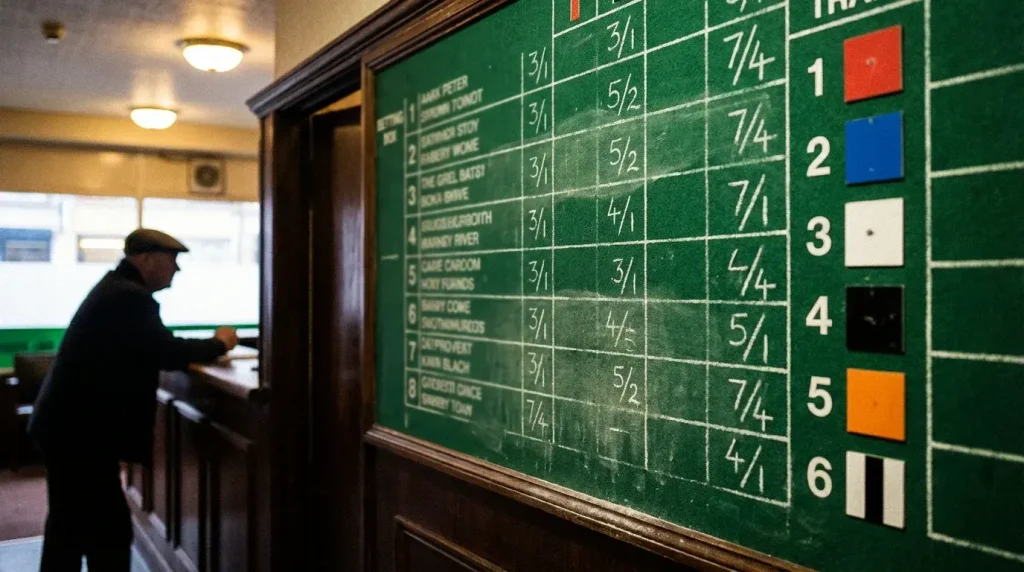
The Price on the Board Is Telling You Something
Every greyhound race begins with a set of numbers beside each dog’s name. Those numbers — the odds — are the single most important piece of information on the screen, and most casual bettors barely glance at them before picking their favourite trap colour. That’s a mistake. Odds aren’t decoration; they’re a market signal compressed into two numbers, and learning to read them properly separates the people who bet on greyhounds from the people who understand greyhound betting.
At its core, an odds price represents the bookmaker’s implied probability of a particular outcome. A dog priced at 2/1 is considered to have roughly a 33% chance of winning. A dog at 5/1 sits closer to 17%. These aren’t exact probabilities — the bookmaker builds in a margin, which we’ll get to — but they reflect the weight of money, the form data, the trap draw analysis, and the professional assessment of every runner in the field. When the odds move, the market is talking. Learning the language is non-negotiable if you want to bet seriously.
Greyhound odds behave differently from horse racing markets, and that matters. With only six dogs in most UK races (GBGB), the market is tighter, the price swings are sharper, and the window between early prices and the off is often measured in minutes rather than hours. A horse can drift from 8/1 to 14/1 across an afternoon; a greyhound’s price might shift from 5/2 to 7/4 in the time it takes to walk from the car park to the stand. The smaller the field, the more each piece of information — a non-runner, a weight change, a kennel whisper — moves the needle.
This article breaks down everything behind those numbers. We’ll cover fractional and decimal formats, explain how Starting Price is formed, decode the bookmaker’s overround, and walk through the mechanics of spotting genuine value. Whether you’re new to the dogs or just tired of backing favourites without understanding why they’re favourites, this is where the education starts.
Fractional Odds — The Traditional Format
How to Read Fractional Odds
Fractional odds are the format you’ll see chalked on betting shop boards and displayed by most UK bookmakers by default. They look like this: 3/1, 5/2, 11/4, 1/5. The number on the left is the profit you stand to make, and the number on the right is the stake required to earn that profit.
Take 3/1. For every £1 you stake, you receive £3 in profit if the dog wins, plus your original £1 back. Total return on a £1 bet: £4. At 5/2, a £2 stake generates £5 profit, so a £1 bet returns £3.50 total. The maths isn’t difficult once you see the pattern — divide the left number by the right number and add one to find the total return per pound staked.
Short-priced favourites use odds where the left number is smaller than the right. A dog at 1/5 is heavily fancied: you need to stake £5 to win just £1 profit. Return on a £5 bet is £6. These odds imply the bookmaker thinks this dog wins more often than not — significantly more often, in fact. At the other end, a 10/1 outsider offers £10 profit per £1 staked. It’s appealing on paper, but the market is telling you this dog has roughly a 9% chance of crossing first.
Mid-range prices like 7/2, 4/1, and 9/2 sit in the territory where most of the betting value lives in greyhound racing. These are dogs with genuine claims on the race — not rank outsiders, not stone-cold certainties — and understanding how to quickly calculate returns at these prices is a practical skill. A £5 bet at 7/2 returns £22.50 (£17.50 profit plus £5 stake). A £10 bet at 9/2 returns £55. You’ll process these faster with practice than you will with a calculator.
Converting Fractions to Implied Probability
Fractional odds encode a probability, and extracting it takes one formula: divide the denominator (right number) by the sum of both numbers, then multiply by 100. For 3/1, that’s 1 ÷ (1 + 3) × 100 = 25%. The bookmaker’s price implies this dog has a one-in-four chance of winning.
Run the formula across a full six-dog race and something interesting happens. Take a market priced at evens, 3/1, 4/1, 5/1, 8/1 and 10/1. The implied probabilities are 50%, 25%, 20%, 16.7%, 11.1% and 9.1% — which adds up to approximately 131.9%. In a fair market, total probability would be exactly 100%. The excess — 31.9 percentage points in this example — is the bookmaker’s overround, the built-in margin that guarantees a theoretical profit regardless of which dog wins. We’ll explore overround in its own section, but recognising it here matters because it tells you that the implied probabilities from odds are always inflated. Every dog’s real chance is somewhat lower than the odds suggest.
Knowing implied probability is useful because it gives you a common language for comparing prices. A dog at 7/4 (36.4% implied) versus 2/1 (33.3% implied) looks like a small gap in fractions, but in percentage terms, the bookmaker sees one of these dogs as noticeably more likely to win. When you start comparing your own assessment — this dog wins one in three, I think — against the market’s number, you’re thinking about value. And value, not just winners, is what betting profitably actually requires.
For those who like mental shortcuts: odds-on prices (anything under evens) always imply better than 50%. Evens is exactly 50% before margin. 2/1 is roughly 33%. 4/1 is roughly 20%. 10/1 is roughly 9%. Memorise those anchor points and you can estimate most greyhound prices in your head within a couple of seconds.
Decimal Odds — The Cleaner Number
Decimal odds skip the mental arithmetic. The number you see includes your stake, so the total return calculation is just: stake × decimal odds. A dog at 4.00 with a £5 bet returns £20 — that’s it. No splitting fractions, no adding the stake back. This is why decimal format dominates on betting exchanges, European sportsbooks, and increasingly across UK bookmaker apps that give you the option to toggle.
Converting between formats is straightforward. Take the fractional odds, divide the left number by the right number, and add 1. So 3/1 becomes (3 ÷ 1) + 1 = 4.00. The familiar 5/2 becomes (5 ÷ 2) + 1 = 3.50. And 1/5 becomes (1 ÷ 5) + 1 = 1.20, a price that immediately tells you the return barely exceeds the stake. Going the other way — decimal to fractional — subtract 1 and express the result as a fraction: 4.50 becomes 3.50/1, which simplifies to 7/2.
Implied probability from decimal odds is even simpler than from fractions: divide 1 by the decimal price and multiply by 100. A dog at 3.00 has an implied probability of 33.3%. A dog at 1.50 implies 66.7%. The lower the decimal number, the shorter the price and the higher the bookmaker’s assessed chance of winning.
In practical terms, the format you use is a preference, not a strategic choice. Some bettors find decimal cleaner for comparing odds across bookmakers, especially when prices are tight. The difference between 3.50 and 3.60 is instantly visible; the difference between 5/2 and 13/5 requires a moment of translation. If you’re shopping for the best price — and you should be — decimal makes the comparison faster. Most UK bookmakers allow you to switch between formats in your account settings, and there’s no penalty for using either. Pick whichever makes the maths feel effortless, because you’ll be doing it dozens of times in a single race meeting.
Starting Price vs Early Odds — Timing Your Bet
The price at 10am and the price at trap-rise can be different animals. In greyhound racing, the odds you see when a market first opens aren’t fixed — they’re the bookmaker’s opening assessment, shaped by form data, track patterns, and the early weight of money from sharp punters. Between that moment and the moment the traps spring open, the price can shift substantially. Understanding why it moves, and when to act, is one of the quieter skills in greyhound betting — and one of the most profitable.
How Starting Price Is Formed
The Starting Price — SP — is the official odds at the moment a race begins. In UK greyhound racing, SP is determined by a process that blends the prices offered by on-course bookmakers (where they still operate) and, increasingly, the weight of money on exchanges and online platforms. For most BAGS meetings and evening cards, the SP reflects the prevailing odds across the major bookmakers at the off. It’s the benchmark price, the one your bet settles at if you don’t take a fixed early price.
SP formation in greyhounds is faster and more volatile than in horse racing because the market window is shorter. Horse racing ante-post markets can open days or weeks before a race. Greyhound prices typically appear the morning of the meeting, sometimes only an hour or two before the first race. That compressed timeline means information has less time to be absorbed gradually. A trainer reporting that a dog trialled well, or a track reporting rain softening the sand, can cause a visible lurch in the market within minutes.
For the bettor, SP serves two functions. First, it acts as a safety net: if you haven’t taken an early price, your bet settles at whatever SP turns out to be. Second, it’s a reference point. Comparing the price you took against the eventual SP tells you whether you captured value or left it on the table.
When to Take Early Price vs Waiting for SP
The early price is worth taking when you have a strong opinion on a dog and expect the market to agree with you — eventually. If a dog has winning form, a favourable trap draw, and today’s conditions suit its running style, the morning price of 4/1 might well be 5/2 by the off. Taking 4/1 early locks in the larger return. This is the classic scenario where early movers are rewarded: you’ve done the analysis, you believe the dog is overpriced, and you act before the market catches up.
On the other hand, SP is the safer option when there’s uncertainty. If you’re unsure about how a dog handles tonight’s track conditions, or there’s a question mark over a rival’s fitness, waiting gives you the benefit of late information. Non-runner announcements, in particular, can redraw the entire market. A withdrawn favourite pushes every other dog’s price shorter, and if you’ve already locked in a price on a second favourite, you’ve missed a potentially better SP on an outsider whose chances just improved.
Best Odds Guaranteed — BOG — eliminates most of this dilemma. Offered by several UK bookmakers on greyhound racing, BOG means you take the early fixed price, but if the SP turns out to be higher, the bookmaker pays you at the better price. It’s a free insurance policy that removes the downside of betting early. If a bookmaker offers BOG on greyhounds, use it. You capture the upside of early value and the safety of SP, at no additional cost. Not every bookmaker extends BOG to every greyhound meeting, so check the terms — BAGS meetings are almost always covered, while some evening RPGTV cards may not be.
The Bookmaker’s Margin (Overround)
Every greyhound market is priced to give the bookmaker an edge — the question is how large that edge is. The overround, sometimes called the vig or the book percentage, is the built-in profit margin that ensures a bookmaker can pay out on any outcome and still, over time, come out ahead. Understanding it won’t make it disappear, but it will change how you assess whether a price is fair.
Here’s how it works in a six-dog race. Convert every runner’s fractional odds to implied probability and add them up. In a perfectly fair market, the total would be 100% — every outcome covered, no margin for the house. In reality, that total is always above 100%. A typical BAGS greyhound market might add up to around 118-125%. An evening RPGTV card, especially a graded race with less form data, might run as high as 130%. The difference between that total and 100% is the overround. A 120% book means the bookmaker has a theoretical margin of roughly 20 percentage points spread across the field.
What does that mean for you as a bettor? It means every dog in the race is priced slightly shorter than its true probability warrants. If a dog’s genuine chance of winning is 25%, a fair price would be 3/1. In a 120% book, that same dog might be priced at 5/2 — still implying around 28.6%, slightly higher than its real chance. The bettor absorbs the difference. Over dozens or hundreds of bets, that margin compounds into a structural disadvantage that only disciplined value betting can overcome.
Comparing overrounds between bookmakers is a genuinely useful exercise, especially if you’re betting on the same race across multiple accounts. A market with a 118% book gives you better raw prices than a market at 126%. The difference might only be a tick or two on each runner, but across a full evening’s racing — ten races, three or four bets per meeting — those ticks add up. Greyhound overrounds tend to be higher than football or horse racing markets because the fields are smaller and the turnover is lower, which means bookmakers compensate with wider margins. Accepting that reality is the first step; shopping for the tightest book is the second.
Spotting Value in Greyhound Odds
Value is when your assessment of a dog’s chance is higher than the odds suggest. It’s a concept that sounds simple but takes discipline to apply, because it requires you to separate the question “will this dog win?” from the more important question “is this dog’s price too big?” A dog can be a likely loser and still represent value. A dog can win and still have been a bad bet. Value is about the price relative to the probability, not the outcome.
Here’s a practical example. You’ve studied the racecard for a mid-grade A4 race at Monmore. There are six runners. One of them, drawn in trap 2, has strong recent form — two wins and a second in its last three runs — but is returning from a three-week break and the market has drifted it to 4/1. You look at the form, the trap draw (favourable at Monmore for early-pace dogs), and the conditions (dry track, fast sand, suits this dog’s running style). Your assessment puts this dog’s winning chance at around 30%. At 4/1, the implied probability is 20%. Your number is higher than the market’s number. That’s value, regardless of whether the dog wins tonight.
The hard part is arriving at your own probability estimate with any reliability. Nobody can calculate precise percentages for a greyhound race — there are too many variables. But you can develop a rough hierarchy. Look at the last six runs for each dog. Factor in trap draw statistics at the track. Adjust for conditions. Ask yourself honestly: how many times out of ten would this dog win this specific race? If your answer is three times out of ten, and the bookmaker is offering 4/1 (implying twice out of ten), you have a case for value.
Value betting only works as a long-term strategy. Individual results are noise. You’ll back dogs at value prices and they’ll lose — frequently. The point is that over hundreds of bets, consistently finding prices that exceed the true probability produces a positive expected return. It’s the same principle that underpins every professional betting approach in every sport. In greyhound racing, the thin liquidity and rapid market formation make value both harder to find and quicker to disappear, which is why preparation before the meeting — not during it — is where most of the edge is built.
One practical habit: before placing any bet, mentally state the dog’s implied probability from the odds, then ask yourself whether you genuinely believe its chance is higher. If you can’t articulate why, you’re not betting on value — you’re betting on hope. The distinction matters more than any system or formula.
Odds Movements — Reading the Market
A price shortening from 5/1 to 3/1 before the race tells a story, if you know how to read it. Odds move because money talks. When a significant amount of money lands on a particular dog, the bookmaker shortens that dog’s price to limit their liability and lengthens the prices on the rest of the field to rebalance the book. This is supply and demand applied to probability — the more people back a dog, the less the bookmaker wants to pay out on it.
Not all movements are equal. A steady drift from 3/1 to 4/1 across a morning usually reflects lukewarm public interest — the dog isn’t attracting support, and the bookmaker is nudging its price out to tempt bets. That’s organic and largely meaningless. A sharp contraction — 6/1 to 3/1 in the space of twenty minutes — is something else entirely. In greyhound racing, that kind of move is often described as a “gamble” and it typically means serious money from informed sources. Kennel connections, regular track-goers, or professional punters who’ve seen the dog trial might be behind it. Or it might simply be one large stake from a single punter distorting a thin market. Greyhound markets carry less liquidity than horse racing, so a few hundred pounds placed in quick succession can produce dramatic price shifts.
Exchange markets — particularly Betfair — add another layer. When exchange money piles onto a dog, the bookmaker’s on-site traders notice and often adjust their own prices accordingly. The exchange acts as a leading indicator: if a dog’s exchange price shortens before the bookmaker moves, sharp punters are likely ahead of the public. Watching the exchange price alongside the bookmaker’s fixed odds gives you a real-time read on where the informed money is flowing.
Steam moves — sudden, heavy drops in price — are worth monitoring but not blindly following. By the time you notice a greyhound has gone from 5/1 to 5/2, the value is already gone. The people who profited were the ones who backed it at 5/1 before the move started. Chasing a shortening price is one of the most common mistakes in greyhound betting. Instead, use movements as information: if a dog you’ve already identified as a contender starts shortening, that’s confirmation. If a dog you dismissed starts steaming in, it’s worth asking what you might have missed. But if your only reason for backing a dog is that its price is contracting, you’re following the crowd rather than thinking for yourself, and the crowd isn’t always right.
The Number That Decides Your Night
Every bet starts with a price. Before the trap draw analysis, before the form study, before the weather check and the running-style comparison, there’s a number on a screen — and your decision to accept it or walk away is the most consequential moment in the entire betting process. Everything else is preparation. The price is the commitment.
Odds literacy isn’t glamorous. It doesn’t produce the dopamine hit of watching your dog lead off the bend or the satisfaction of calling a 10/1 winner. But it’s the foundation that makes those moments mean something financially rather than just emotionally. A bettor who understands implied probability, recognises when a bookmaker’s margin is eating into their returns, and knows the difference between a genuine value price and a big number that looks tempting — that bettor has an edge before the first race even starts.
The greyhound market’s speed is both its challenge and its appeal. Prices form quickly, move quickly, and settle quickly. There’s no time for lengthy deliberation at the track or on the app. You either know what the odds are telling you, or you’re guessing. And guessing, over the course of a season’s racing, has a very predictable outcome.
What makes greyhound odds particularly worth studying is the transparency of the sport. Six dogs, one distance, known form, published trap statistics, visible conditions. The variables are finite and, for the most part, measurable. That means odds in greyhound racing are among the most efficient in any betting market — which, counterintuitively, means that the edges are small but real. You won’t find a 20/1 shot that should be 4/1. You will find a 7/2 shot that should be 5/2, and over hundreds of bets, finding those consistently is the difference between losing slowly and winning quietly. The number on the board is telling you something. Make sure you’re listening.
Find more odds guides at greyhoundlivestream.
Also read our starting price vs early price in greyhound betting.
